

Patients are searching for pharmacies and clinics online right now, and if your practice isn’t showing up, a competitor is getting that business instead. The shift in patient behavior is real: most people search online before choosing a healthcare provider, and independents without a strong digital presence are quietly losing patients they never even knew were looking. This guide walks you through a practical, compliance-first approach to building online visibility, attracting new patients, and keeping them engaged long-term. No generic marketing hacks. Just strategies that actually work for independent pharmacies and medical practices.
Table of Contents
-
Implementation: Boost your practice with impactful strategies
-
Why independent healthcare practices must blend personal touch with digital innovation
Key Takeaways
| Point | Details |
|---|---|
| Audit current presence | Understanding your digital baseline is the first step to meaningful improvement. |
| Prioritize compliance | HIPAA and patient trust should shape every online marketing decision. |
| Leverage modern tools | AI-driven SEO and local targeting can dramatically boost patient engagement. |
| Blend offline with online | Integrating personal touch with digital strategies maximizes impact for independents. |
| Optimize relentlessly | Continuous measurement and adjustment keep your healthcare brand visible and compliant. |
Assess your current digital footprint
Before you spend a single dollar on ads or redesign your website, you need to know exactly where you stand. Think of this as a health check for your online presence. You can’t treat what you haven’t diagnosed.
Start by auditing these core digital assets:
-
Your website: Is it mobile-friendly? Does it load in under three seconds? Are your hours, address, and phone number accurate? Check your website optimization tips to see what gaps are most common.
-
Google Business Profile (GBP): Is your profile claimed and fully filled out? Missing categories, outdated hours, or no photos are all red flags.
-
Review sites: Healthgrades, Yelp, and Zocdoc matter. Check your ratings, response rates, and whether your contact info is consistent across all of them.
-
Social media: Do your profiles exist? Are they active? Dormant accounts can actually hurt trust.
-
NAP consistency: Your Name, Address, and Phone number need to match exactly across every platform. Even small differences confuse Google and erode local search rankings.
Here’s a quick reference table to guide your audit:
| Digital asset | What to check |
|---|---|
| Website | Mobile-friendliness, load speed, HIPAA notices, accurate contact info |
| Google Business Profile | Claimed status, categories, photos, hours, Q&A |
| Review platforms | Rating scores, response rate, NAP consistency |
| Social media | Active presence, branding consistency, no PHI in posts |
| Email marketing | Encryption in place, BAA with vendor, consent collected |
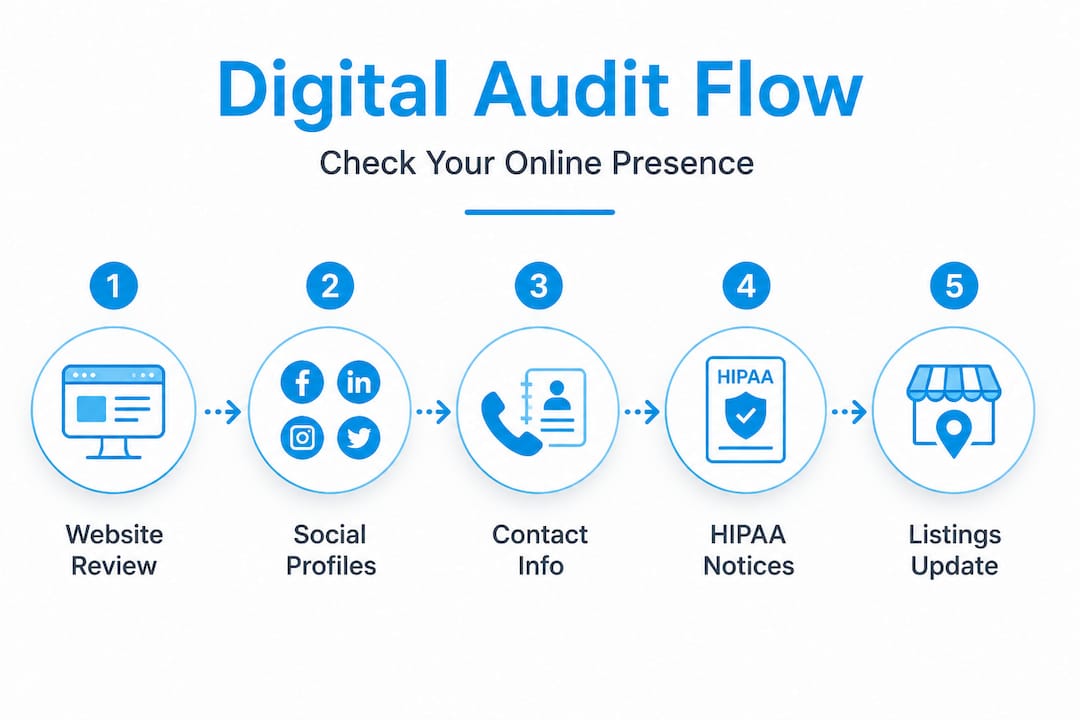
One thing that catches a lot of independent practices off guard: HIPAA compliance in digital marketing means no protected health information (PHI) in emails, social posts, or ads. You also need encryption, business associate agreements (BAAs) with your vendors, and you must exclude tracking pixels from any patient portal pages. These aren’t optional. They’re baseline requirements.
For pharmacies specifically, your pharmacy website optimization checklist should also include verifying that prescription refill tools and patient-facing forms are hosted on HIPAA-secure infrastructure.
Pro Tip: Build a simple spreadsheet with every digital asset listed and a column for “last reviewed.” Run through it quarterly. Consistency over time is what builds authority in local search.
Lay the foundation: Compliance and trust
With your baseline in hand, it’s essential to ensure your next steps don’t jeopardize compliance or trust.
HIPAA isn’t just a legal requirement. It’s a trust signal. Patients are increasingly aware of data privacy, and one breach or careless social post can undo years of goodwill. The good news is that staying compliant and building trust actually go hand in hand.
Here’s what HIPAA-compliant marketing looks like in practice. There’s an important distinction between treatment communications and marketing communications. Appointment reminders sent through a secure portal? That’s treatment-related and has more flexibility. An email blast promoting a new service using patient data? That requires explicit consent. The lines matter.
Do’s:
-
Use a HIPAA-compliant patient portal for any sensitive communication
-
Get written consent before using any patient information for marketing
-
Work only with vendors who will sign a BAA (Business Associate Agreement)
-
Use general, educational content on social media and your website
-
Display a clear privacy policy on your website
Don’ts:
-
Share patient names, conditions, or any identifying info on social media
-
Use retargeting pixels on pages where patients log in or enter health data
-
Send marketing emails through non-encrypted platforms like standard Gmail
-
Assume “de-identified” data is always safe without legal review
-
Use testimonials that reveal health conditions without documented consent
One privacy incident is all it takes to lose a patient’s trust permanently. Build your digital presence on a foundation of security and transparency, and patients will reward you with loyalty.
The practical move here is to keep your HIPAA-compliant website design and your marketing channels clearly separated in terms of data flow. Your website can inform and attract. Your secure portal handles anything sensitive. That separation protects you and reassures patients.
Pro Tip: Use portals for PHI and sensitive follow-ups. Use your website, social media, and email newsletters for general health education and community engagement. Never mix the two.
Implementation: Boost your practice with impactful strategies
With trust and compliance established, you’re ready to put proven strategies into action.
Here’s the reality: independent pharmacies and clinics have a genuine edge over big chains. You know your patients by name. You’re embedded in the community. The problem is that edge is invisible online if you haven’t built a digital presence to show it. These five steps fix that.
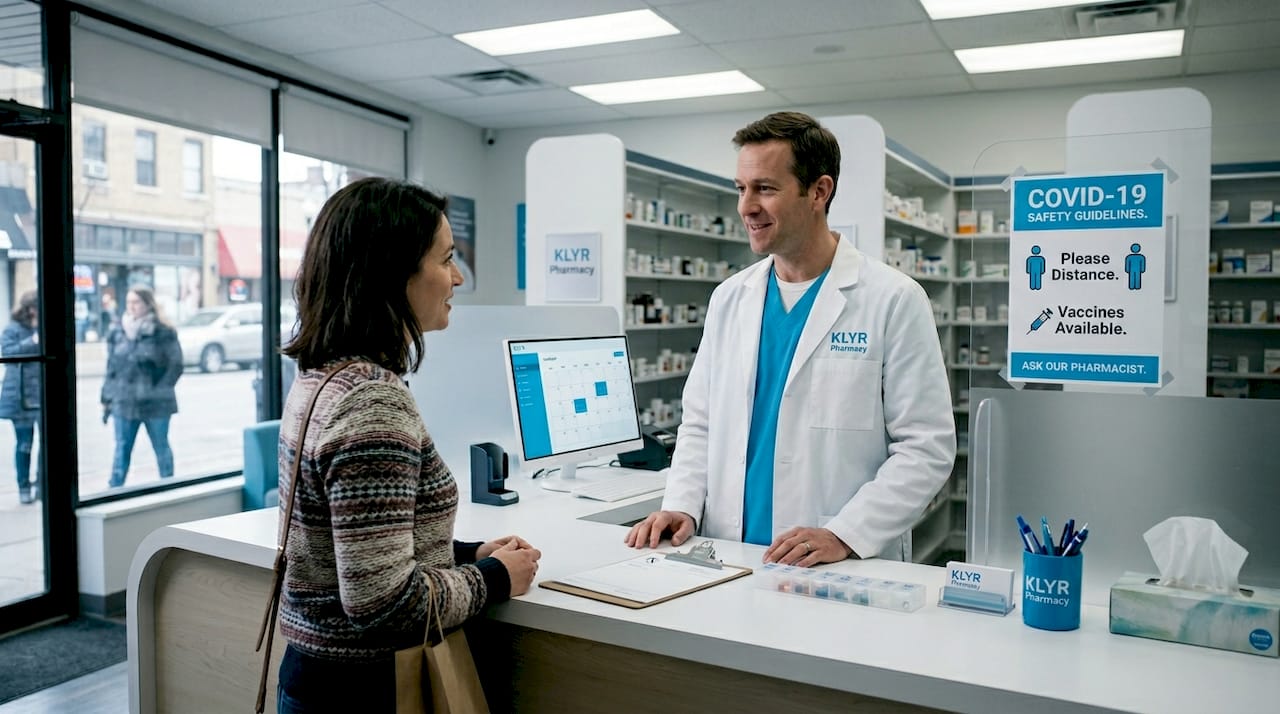
1. Update your website for patients, not just search engines. Your site should answer the questions patients actually have: What services do you offer? Are you accepting new patients? How do I refill a prescription? Make sure every page is mobile-optimized, loads fast, and has a clear call to action. Review these website optimization tips for healthcare to prioritize your fixes.
2. Claim and fully optimize your Google Business Profile. This is the single highest-leverage action for local visibility. Add photos, update your service list, respond to every review, and post weekly updates. A fully optimized Google Business Profile can put you on the map literally and figuratively for patients searching nearby.
3. Manage your online reviews actively. Ask satisfied patients to leave reviews. Respond professionally to negative ones. Review volume and recency both factor into local search rankings. A practice with 80 reviews and a 4.7 rating will almost always outrank one with 12 reviews and a 4.9.
4. Engage on social media with educational content. Post about seasonal health topics, medication reminders, and community events. Stay away from anything patient-specific. Consistent, helpful content builds trust with people who haven’t visited yet and keeps you top-of-mind with existing patients.
5. Launch targeted, privacy-compliant ads. When you’re ready to invest in paid traffic, geo-targeted ads focused on your service area are powerful. Use best keywords for healthcare that reflect what local patients actually search, like “pharmacy near me open Sunday” or “walk-in clinic for UTI.”
Now here’s where the data gets interesting. AI-powered SEO and geo-targeting can boost conversions up to 13 times compared to traditional online marketing. That’s not a small difference. That’s the gap between a practice that’s growing and one that’s stagnant.
| Factor | Traditional marketing | Digital marketing | Best combined approach |
|---|---|---|---|
| Reach | Local community, referrals | Broad, searchable | Hyperlocal digital targeting |
| Cost | High (print, events) | Scalable | Start digital, reinforce offline |
| Measurability | Low | High | Track digital, credit offline |
| Personal touch | High | Medium | Use digital to amplify personal brand |
| Speed to results | Slow | Fast | Quick digital wins, long-term trust |
The pharmacy advertising research from IPC makes a compelling case for integration. Traditional methods like referrals and community presence still matter, but they need digital amplification to reach patients who are searching before they ever walk in the door. The practices winning right now are doing both.
Pro Tip: Create hyperlocal content that mentions your neighborhood, nearby landmarks, or community events. “Flu shots available near downtown Riverside” will outperform generic “flu shots available” every time for local search.
For a broader look at promoting local clinics online, the fundamentals stay the same: be specific, be local, and be consistent.
Verify your results and optimize continuously
After launch, your work isn’t done. Let’s look at how you can maintain momentum and outpace competitors.
Putting strategies in place is step one. Knowing whether they’re working is step two. A lot of practices skip step two, and that’s where momentum dies. You don’t need a data science degree to track what matters. You need a short list of key performance indicators (KPIs) and a habit of checking them.
KPIs to track:
-
Website traffic: Total visitors, where they came from (organic, paid, referral), and how long they stayed
-
Online bookings and calls: Are more patients converting from your site?
-
Google Business Profile views: How many people saw your listing and clicked?
-
Review scores and volume: Are you getting new reviews consistently?
-
Search rankings: Are you showing up for your target keywords in your city?
The tools don’t need to be expensive. Google Analytics (free) tracks site traffic and user behavior. Google Search Console (also free) shows which search terms bring people to your site. For reputation management, tools like Birdeye or Podium aggregate reviews across platforms in one dashboard.
Interpreting the data is where most practices get stuck. Here’s a simple rule: if traffic is up but bookings are flat, your website has a conversion problem. If rankings are dropping, check whether a competitor recently updated their content or got a surge of reviews. If review scores dip, look at what changed in your patient experience.
Watch for these warning signs that it’s time to adjust your strategy:
-
Website traffic drops more than 15% month over month without a clear reason
-
Your Google Business Profile views decline for two consecutive months
-
Competitors are outranking you for keywords you previously owned
-
Review volume drops to zero for more than 30 days
-
Ad click-through rates fall below 1% on campaigns that previously performed well
AI visibility tracking is also becoming a 2026 priority. As AI-generated search results and voice search grow, practices that monitor how they appear in AI-driven answers will have a real edge.
Commit to a monthly review of your core KPIs. Quarterly, do a deeper audit. Use your findings to update content, adjust ad targeting, and refine your local SEO. The practices that treat digital marketing as an ongoing system rather than a one-time project are the ones that keep growing. Explore healthcare SEO services if you want a structured approach to continuous optimization.
Why independent healthcare practices must blend personal touch with digital innovation
Here’s the perspective that doesn’t get said enough: the biggest mistake independent pharmacies and clinics make isn’t being bad at digital marketing. It’s assuming their reputation speaks for itself.
You’ve built real relationships with patients. You remember their names, their families, their medication histories. That’s genuinely rare. But here’s the uncomfortable truth: a new patient moving into your neighborhood doesn’t know any of that. They’re searching Google. And if they find a polished chain pharmacy with 200 reviews and a clean website before they find you, they’re going to that chain. Not because it’s better. Because it was easier to trust online.
The research on traditional versus digital pharmacy advertising confirms what we see in practice. Community trust and referrals are still powerful. But they need a digital layer to reach people before they’ve already made a decision. Your personal touch is your competitive advantage. Digital tools are how you broadcast it to people who haven’t met you yet.
The practices that are winning right now aren’t choosing between personal service and digital presence. They’re using digital to amplify the personal. They post videos of their pharmacist answering common questions. They respond to every review with warmth and specificity. They write blog posts about local health concerns. They show up in search results and in the community.
The future belongs to independent practices that are just as confident online as they are behind the counter.
This isn’t about becoming a tech company. It’s about making sure the trust you’ve earned offline is visible to the patients who are looking for you online. Blending offline and online engagement is the strategy that separates practices that grow from practices that slowly lose ground to competitors who figured this out first.
Next steps: Get expert support for your healthcare practice
If you’re ready to make your online presence a competitive advantage, professional support can help you go further, faster.
The strategies in this guide work. But executing them consistently while running a busy pharmacy or medical practice is genuinely hard. That’s where having a partner who understands both healthcare compliance and digital marketing makes a real difference.
At KLYR Media, we work exclusively with independent pharmacies and medical practices. We know the HIPAA nuances, the local SEO dynamics, and the patient behavior patterns that generic agencies miss. Whether you need specialized healthcare SEO to climb local rankings, secure web design services that meet compliance standards, or HIPAA-compliant PPC advertising that drives real patient volume, we build systems tailored to your practice. Reach out for a free assessment and let’s identify exactly where your biggest opportunities are.
Frequently asked questions
What are the main HIPAA concerns when marketing a healthcare practice online?
Never include PHI in emails, social posts, or ads, and always use encrypted platforms with signed BAA vendors and explicit patient consent for any marketing communications.
How can independent pharmacies compete with big retail chains online?
Independents win by highlighting local ties and personalized service, using digital marketing strategies to reach nearby patients with relevant, trusted information that chains can’t replicate.
What’s the biggest digital “quick win” for healthcare practices?
Optimizing your Google Business Profile is the fastest path to higher local visibility, more patient calls, and better search rankings in your service area.
Why is AI-powered SEO so effective for medical practices?
AI and geo-targeted SEO can deliver conversion rates 13 times higher than traditional online marketing, making it one of the highest-return investments for independent practices in 2026.
How do I track the success of my digital efforts?
Monitor website traffic, online bookings, and review volume using Google Analytics and Google Search Console, then adjust your strategy monthly based on what the data shows.
Recommended
-
Website Optimization for Healthcare: Improve Patient Experience & Online Bookings | Blog
-
How to Promote Your Healthcare Clinic Location: Local Patient Acquisition Strategies | Blog
-
Medical Clinic Solutions | Custom Practice Management Software | KLYR Media | KLYR Media
-
How to Optimize Your Google Business Profile for Healthcare Clinics & Medical Facilities | Blog