

Most healthcare administrators assume brand building means a fresh logo, a new color palette, and maybe a social media push. That assumption is costing you patients. Real healthcare brand building is grounded in something far less glamorous and far more powerful: the actual experience patients have when they walk through your door, call your front desk, or try to get a refill. The organizations that get this right don’t just look trustworthy. They are trustworthy, and patients feel it every single time.
Table of Contents
Key Takeaways
| Point | Details |
|---|---|
| Brand equals patient trust | The foundation of healthcare branding is building and sustaining patient trust through every interaction. |
| Experience drives perception | Care coordination, teamwork, and empathy have far more impact on brand reputation than digital tactics alone. |
| Measure what matters | Prioritize patient experience and engagement metrics over vanity metrics for true brand health insights. |
| Amplify, don’t substitute | Digital strategies should reinforce, not replace, experience-based brand building initiatives. |
What is healthcare brand building?
Let’s get the definition right before we go any further. Healthcare brand building is the ongoing process of creating, communicating, and sustaining a trustworthy identity for your organization. Notice what’s missing from that definition: logos, fonts, and taglines. Those things exist, sure, but they’re not the engine.
In retail, a strong visual identity can carry a brand a long way. Healthcare is different. Patients aren’t choosing between cereal boxes. They’re deciding who to trust with their health, their family’s wellbeing, and sometimes their lives. That changes everything.
What actually shapes your brand in healthcare:
-
How your staff communicates with patients during visits and over the phone
-
How care is coordinated across providers and departments
-
Whether patients feel heard by their physician or pharmacist
-
Your organization’s reputation in the local community
-
Consistency across every patient touchpoint
Research from AHRQ confirms that patient engagement levers influencing experience scores and brand perception include care coordination, teamwork and communication, and physician empathy. Digital tactics alone don’t move those ratings.
This is where digital healthcare transformation fits in. It’s not a replacement for great care. It’s a way to amplify the genuine experience you’re already delivering.
The components of a strong healthcare brand
With a baseline definition in place, let’s break down what actually builds a healthcare brand. There are two categories: tangible and intangible.
Tangible elements are the ones most administrators focus on:
-
Name, logo, and visual identity
-
Website design and functionality
-
Physical environment, signage, and cleanliness
-
Marketing materials and advertising
Intangible elements are where the real brand lives:
-
Patient trust earned over time
-
Staff empathy and bedside manner
-
Reputation for reliability and follow-through
-
Internal culture and how staff treat each other
Here’s a quick comparison to make this concrete:
| Brand asset type | Examples | Impact on patient perception |
|---|---|---|
| Visual/tangible | Logo, website, signage | First impression, credibility signal |
| Experiential/intangible | Empathy, care coordination, communication | Long-term loyalty, word-of-mouth referrals |
| Operational | Wait times, billing clarity, follow-up calls | Retention and satisfaction scores |
| Digital | Online reviews, social media, local listings | Discoverability and reputation reinforcement |
The intangible column is where most organizations are leaving brand equity on the table. AHRQ research shows that CG-CAHPS scores, which are standardized patient experience measures used widely across U.S. healthcare, improved specifically with interventions like care coordinators for chronic conditions, peer shadow coaching, better team communication, and physician empathy training.
That’s not a marketing campaign. That’s operational culture.
Strong website optimization for healthcare matters too, but it works best when it reflects a genuine patient experience, not a manufactured one.
Patient experience: The engine behind brand reputation
Here’s the uncomfortable truth most marketing vendors won’t tell you. You can spend $50,000 on a rebrand and watch your patient satisfaction scores stay flat. Or you can invest in a care coordinator for your highest-risk chronic disease patients and watch your reputation improve organically within months.

AHRQ data shows that interventions like patient portals, EHR upgrades, and technology tools for complex patients showed no statistically significant impact on patient experience ratings. Meanwhile, empathy coaching and communication training moved the needle consistently.
That’s a counterintuitive finding, and it matters for how you allocate your budget.
Comparison: What moves patient experience scores
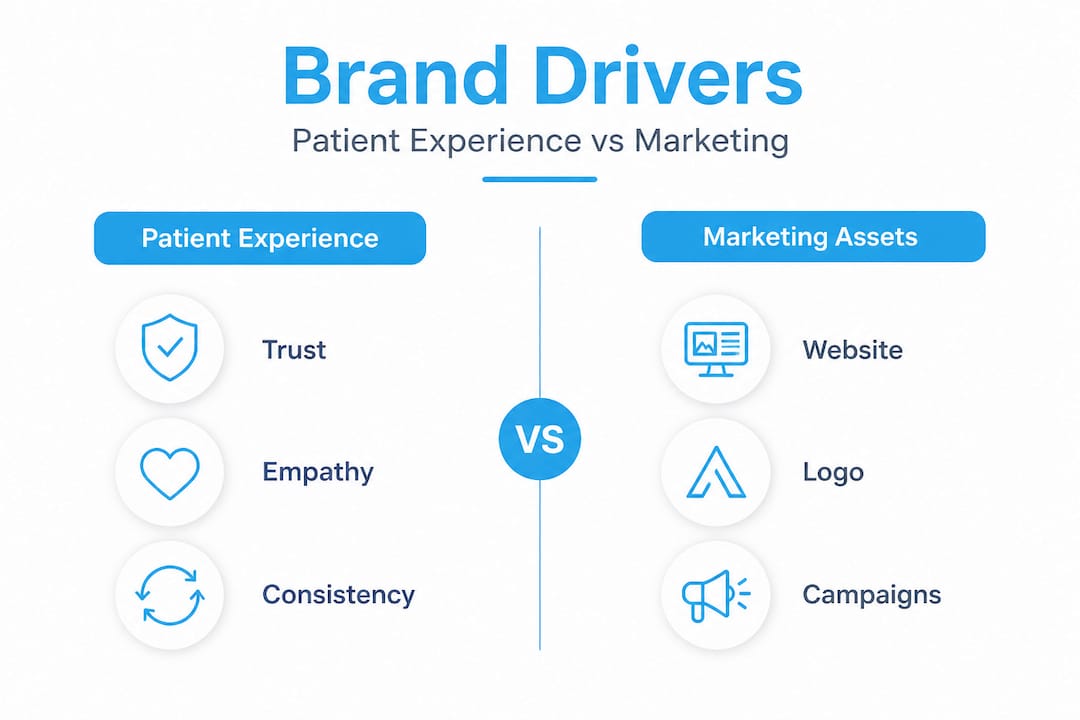
| Intervention | Impact on CG-CAHPS scores | Notes |
|---|---|---|
| Care coordinators for chronic conditions | Significant positive impact | Especially for high-utilization patients |
| Physician empathy coaching | Significant positive impact | Peer shadow coaching works well |
| Team communication training | Significant positive impact | Affects both staff and patient outcomes |
| Patient portals | No statistically significant impact | Useful tool, but not a brand-builder alone |
| EHR implementation | No statistically significant impact | Infrastructure, not experience |
| Complex patient care programs | No statistically significant impact | Without empathy component, limited effect |
So what can your organization do right now to improve experience-driven branding? Here are five actions worth taking seriously:
-
Audit your communication touchpoints. How does your front desk answer the phone? What happens when a patient calls after hours? Those moments define your brand more than any ad.
-
Invest in empathy training for clinical staff. Peer shadow coaching, where experienced staff observe and coach newer team members on patient interactions, has a documented positive effect on experience scores.
-
Assign care coordinators to your most complex patients. Chronic disease patients who feel managed and supported become your most loyal advocates.
-
Create a feedback loop. Collect patient experience data regularly, not just through annual surveys. Use it to make operational adjustments quickly.
-
Reward staff who live out your brand promise. If your brand is built on compassion and reliability, recognize the team members who demonstrate those values daily.
Pro Tip: Stop tracking likes and impressions as brand health indicators. Instead, monitor your CG-CAHPS scores, patient retention rates, and online review sentiment. Those numbers tell you whether your brand promise is being kept. For more on improving patient experience online, and how your digital presence can reinforce real-world care, it’s worth reviewing your full patient journey from search to appointment.
Want to understand how local patients find you before they ever walk in? Local patient acquisition tips can help you connect your experience improvements to your discoverability. And if your Google Business Profile optimization is outdated, you’re likely losing patients before they even reach your front door.
Digital strategies: Amplifying the healthcare brand
Digital tools are not the foundation of your brand. They’re the amplifier. Once you’ve built a genuine patient experience worth talking about, digital channels help more people hear about it.
Here’s what actually works in digital healthcare brand building:
-
A clear, fast, mobile-friendly website that answers patient questions without friction
-
Consistent local listings on Google, Yelp, Healthgrades, and similar platforms
-
Active online review management that responds to both positive and negative feedback
-
Social media presence that reflects your organization’s real culture and values
-
Search engine visibility so patients can find you when they need you most
What doesn’t work as a standalone strategy? Investing in a patient portal or upgrading your EHR and expecting brand perception to shift. AHRQ research confirms that these technology interventions showed no statistically significant impact on patient ratings when implemented without complementary experience improvements.
Digital tools are most powerful when they reduce friction for patients who already trust you. A well-designed website helps a loyal patient book an appointment faster. A strong Google presence helps a new patient in your neighborhood find you instead of a competitor. But neither of those tools creates trust from scratch.
Pro Tip: Do a quarterly audit of your digital presence. Check that your hours, address, phone number, and services are accurate across every platform. Outdated information is a brand credibility killer, and it’s one of the easiest fixes you can make today.
For organizations running paid search campaigns, optimizing Google Ads for healthcare requires a clear understanding of what patients are actually searching for. Pairing that with research on best keywords for healthcare marketing ensures your digital spend reaches the right patients at the right moment.
Measuring success: Beyond vanity metrics
You can’t improve what you don’t measure. But you also can’t improve if you’re measuring the wrong things.
Too many healthcare organizations track social media followers, website traffic, and ad impressions as brand health indicators. Those numbers feel good in a board presentation. They rarely tell you whether patients trust you more this quarter than last.
Here are five metrics worth tracking for real healthcare brand health:
-
CG-CAHPS scores for ambulatory care settings. These standardized measures capture patient experience across communication, care coordination, and access to care.
-
Patient retention rate. What percentage of patients return for follow-up care? A declining retention rate is an early warning sign that your brand promise isn’t landing.
-
Online reputation score. Track your average star rating across Google, Healthgrades, and Yelp. More importantly, track the themes in patient reviews. Are patients consistently mentioning empathy? Wait times? Communication?
-
Net Promoter Score (NPS). A simple “how likely are you to recommend us?” question, scored on a scale of 0 to 10, gives you a fast read on patient loyalty.
-
Appointment no-show and cancellation rates. High no-show rates often signal low patient engagement, which is a brand problem, not just a scheduling problem.
Tracking experience outcomes that reflect whether your brand promise is being kept is the standard AHRQ recommends. Awareness metrics like impressions and reach belong in your marketing reporting, not your brand health dashboard.
Tie every metric back to a specific brand promise. If your organization promises accessible, compassionate care, then your metrics should measure access and empathy directly. If those scores aren’t moving, you have a culture problem, not a marketing problem.
The real-world realities of healthcare brand building
Here’s a perspective that might sting a little, but it’s worth saying plainly. Most U.S. healthcare organizations don’t struggle with brand building because they lack marketing budget. They struggle because they’ve confused brand with advertising.
We’ve seen organizations spend six figures on a website redesign while their front desk staff puts patients on hold for 12 minutes. We’ve watched clinics launch Instagram campaigns while their physicians rush through appointments without making eye contact. The brand message says “we care.” The patient experience says something very different.
The hard-won lesson is this: small operational changes almost always outperform large marketing spends when it comes to reputation. A single care coordinator who genuinely follows up with high-risk patients generates more word-of-mouth than a year of Facebook ads. A physician who takes 90 extra seconds to ask a patient how they’re really doing creates a loyalty that no retargeting campaign can replicate.
Culture is the brand. Everything else is communication.
That doesn’t mean digital investment is wasted. Far from it. When you’ve built something genuinely worth talking about, digital tools help you scale that story. Transforming healthcare brands through technology works best when the technology reflects real organizational values, not manufactured ones.
The administrators who get this right are the ones who invest in both. They fix the experience first, then amplify it digitally. They reward the nurse who goes above and beyond, and they make sure that story shows up in their online presence. That combination is what separates organizations with strong brands from those that just have strong logos.
How KLYR Media equips healthcare organizations for brand success
Building a healthcare brand that patients actually trust takes more than good intentions. It takes the right infrastructure, the right digital presence, and a partner who understands the compliance and operational realities of your world.
KLYR Media works exclusively with healthcare organizations, including independent pharmacies, medical clinics, and specialty practices across the United States. We build HIPAA-compliant web design solutions that reflect your genuine patient experience and help new patients find you with confidence. Our general healthcare solutions are designed to amplify the experience improvements you’re already making, not replace them. And our healthcare SEO services ensure that when local patients search for care, they find you first. If you’re ready to build a brand that earns real patient loyalty, let’s talk.
Frequently asked questions
What are the most important elements of healthcare brand building?
The most important elements are patient trust, consistent care experience, staff empathy, and reliable communication. AHRQ research confirms that care coordination, teamwork, and physician empathy are the primary levers influencing patient experience scores and brand perception.
How do patient experience scores impact a healthcare organization’s brand?
High patient experience scores directly enhance brand reputation and patient loyalty, driving both retention and word-of-mouth referrals. CG-CAHPS scores improved specifically with care coordinators, peer shadow coaching, and empathy training, all of which strengthen the brand from the inside out.
Do digital tools like patient portals improve healthcare brand perception?
Not on their own. Patient portals and EHRs showed no statistically significant impact on patient experience ratings when implemented without complementary care experience improvements. Digital tools amplify a strong brand but don’t create one.
What metrics should administrators track for healthcare brand success?
Track CG-CAHPS scores, patient retention rates, online reputation scores, Net Promoter Score, and appointment no-show rates. Experience and engagement outcomes that reflect whether your brand promise is being kept are far more meaningful than impressions or follower counts.
Recommended
-
Website Optimization for Healthcare: Improve Patient Experience & Online Bookings | Blog
-
How to Promote Your Healthcare Clinic Location: Local Patient Acquisition Strategies | Blog
-
Best Keywords to Use for Healthcare Marketing: Patient Acquisition Search Terms | Blog
-
How to Optimize Google Ads for Healthcare: HIPAA-Compliant Patient Acquisition | Blog