

Budget $3,000 to $8,000 for a solo practitioner site, $8,000 to $20,000 for a small to mid-size clinic, and $30,000 to $75,000 or more for a multi-location group or hospital system. Healthcare website cost swings that widely for one reason above all others: compliance and integration. A brochure site with no patient data is cheap. A site with a HIPAA-safe intake form, a patient portal, and an EHR sync is closer to custom software. Run a discovery checklist before you request quotes, so every bid you get back is pricing the same project.
TL;DR:
- Healthcare website costs mainly depend on required integrations like EHR sync and compliance, with complex features pushing prices toward the upper range.
- A HIPAA-safe website with EHR integration can add tens of thousands of dollars beyond basic design, especially if patient data forms are involved.
- Budgeting should focus on scope and compliance needs upfront, as low quotes often omit essential infrastructure like encrypted storage and BAAs.
- Smaller practices typically spend between $3,000 and $20,000, while multi-location systems may pay $30,000 to $75,000 or more for full-featured sites.
- Ongoing costs include hosting, security, SEO, and maintenance, generally constituting 15 to 25 percent of the initial build annually.
Table of Contents
- What Drives Healthcare Website Cost by Practice Type?
- What Do You Actually Pay for, Line by Line?
- Why Does HIPAA Compliance Raise Web Design Costs?
- How Long Does a Healthcare Website Project Take?
- What Are the Ongoing Costs After Launch?
- How Can You Cut Costs Without Cutting Compliance?
- What Should Go in Your Website RFP?
- The Real Budgeting Mistake Practices Keep Making
- Get a Healthcare Website Quote Built Around Your Actual Scope
- Sources
- FAQ
What Drives Healthcare Website Cost by Practice Type?
Practice size sets the baseline, but it's the features layered on top that move a quote from one bracket to the next. A medical website in 2026 typically runs between $3,000 and $75,000, and where you land inside that range depends almost entirely on how much patient-facing functionality you're building.
Solo practitioners usually land at the low end, $3,000 to $8,000. That typically covers a five to eight-page site, a contact form, basic on-page SEO, and maybe a third-party scheduling widget that doesn't touch your EHR. It's enough for a dermatologist or a single-provider dental office that wants to look credible and get found on Google Maps.
Small practices with two to five providers move into $8,000 to $20,000 territory. You're now paying for provider bio pages, insurance and payment information, a real content strategy, and often a booking tool that at least partially talks to your practice management software. This is also where accessibility work starts to matter more, since more pages mean more surface area for ADA compliance issues.
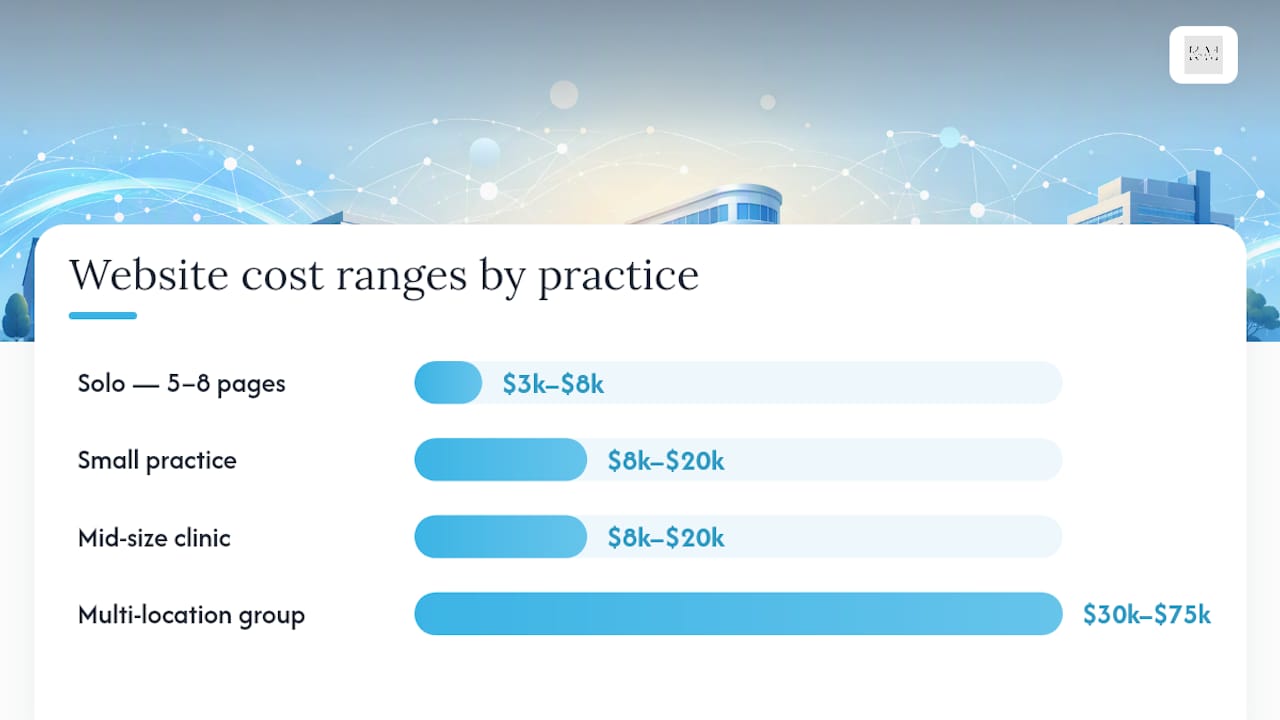
Mid-size clinics sit in a similar $8,000 to $20,000 band, but the money goes toward different things: multi-department navigation, staff directories, and sometimes a basic patient portal for forms and results.
Multi-location groups and hospital systems climb to $30,000 to $75,000 or higher. A location finder with maps and hours per site, provider search filtered by specialty and insurance, and true two-way EHR integration all add engineering hours that a solo site never touches.
A few line items apply across every tier:
- Accessibility and ADA compliance work typically adds $500 to $3,000 to a build, depending on how much remediation existing content needs.
- Multi-location directories and location pages add cost roughly per-location, not as a flat fee.
- Custom photography and video always push a quote toward the top of its bracket.
- Any feature that touches protected health information (PHI) triggers compliance costs regardless of practice size.
Pro Tip: Don't size your budget off your provider count alone. A solo practitioner adding a two-way EHR sync can easily out-cost a five-provider clinic running a simple contact form.
What Do You Actually Pay for, Line by Line?
Agency quotes rarely break down the same way twice, which makes them hard to compare. Knowing the standard components, and what pushes each one from cheap to expensive, lets you read between the lines of any proposal.
- Design: $1,500 to $8,000. Template customization sits at the low end; fully custom UX design with wireframes and a brand system sits at the top.
- Development: $2,000 to $15,000+. A WordPress build with a page builder is cheap. Custom-coded functionality, especially anything interactive, is not.
- Content and copywriting: $500 to $5,000. Reusing your existing brochure text costs almost nothing. Medically reviewed, SEO-optimized copy for every service line adds up fast.
- Booking and scheduling: $0 to $10,000+. A simple embedded link from a third-party scheduler can be nearly free. A two-way sync with your EHR that updates in real time is priced closer to software development.
- EHR/EMR integration: $5,000 to $30,000+. This is the single biggest swing factor on the list, and it's where portals and integrations start pricing like custom software rather than a website.
- Security and compliant hosting: $500 to $5,000 one-time, plus recurring fees. Standard shared hosting is out; you need a BAA-capable host from day one.
- Accessibility (ADA/WCAG): $500 to $3,000, as noted above, and this is easy to underquote if an agency isn't testing with real screen readers.
- QA and testing: $500 to $3,000. Cross-browser, cross-device, and accessibility testing before launch.
The one-time versus ongoing split matters as much as the total. Design, development, and initial content are one-time charges. Hosting, security monitoring, and most SEO work are recurring. An agency quote that lumps everything into a single number without separating those two categories is a red flag worth asking about directly. For deeper detail on what a well-scoped build includes, see this guide to medical website design.
Why Does HIPAA Compliance Raise Web Design Costs?
A standard business website and a healthcare website that touches patient data are not the same build, even if they look identical to a visitor. The difference is invisible infrastructure: encrypted transport, compliant storage, and a signed Business Associate Agreement (BAA) with every vendor that handles that data.
A HIPAA-safe intake flow needs three things at minimum: encrypted transmission (SSL/TLS is the floor, not the ceiling), storage with a vendor willing to sign a BAA, and a hosting environment that logs access and locks down who can see submitted forms. Standard shared hosting plans almost never qualify. Compliant hosting and BAA-capable vendors are the primary reason healthcare projects cost more than a typical small business site.
A simple booking link that just shows open time slots is a different animal from a two-way EHR sync. The link can cost next to nothing. The sync, which pushes and pulls patient data in real time, is priced like custom software, often adding tens of thousands to a build.
That price gap is the single biggest thing buyers underestimate when they compare quotes. Government patient-privacy guidance reinforces why this matters beyond cost: secure handling of patient information isn't optional infrastructure, it's baseline protection for the people trusting you with their health data.
Ignore accessibility and you're taking on legal exposure, not just a design gap. ADA-related web accessibility lawsuits have targeted healthcare organizations specifically because patient-facing sites are considered places of public accommodation. Budget for it upfront rather than as a fix-it-later line item.
- Encrypted forms and BAA-capable storage are non-negotiable the moment PHI enters the picture.
- A booking widget without EHR access costs a fraction of a real two-way sync.
- Accessibility testing should happen before launch, not after a complaint.
- Any vendor touching patient data needs a signed BAA before integration work starts.
For the technical side of what a compliant build actually requires, this HIPAA-compliant website workflow guide walks through the process step by step.
How Long Does a Healthcare Website Project Take?
A simple, template-based site with no PHI collection typically launches in four to eight weeks. A complex build with a patient portal, EHR integration, and multi-location architecture usually runs eight to sixteen weeks or longer.
The stages look roughly the same regardless of scope: discovery and scoping, content and asset collection, design, development, quality assurance, and launch. What changes is how long each stage takes and how many rounds of revision the integration work needs.
The single biggest lever you control is content readiness. Practices that show up to kickoff with provider bios, service descriptions, and photography already organized routinely shave two to four weeks off the schedule. Practices that plan to "write it as we go" almost always extend the timeline, because content delays cascade into design delays, which cascade into development delays.
What Are the Ongoing Costs After Launch?
The build price is only part of the number. Hosting, security monitoring, backups, plugin licenses, and SEO retainers keep running long after launch, and they scale with practice size the same way the initial build does.
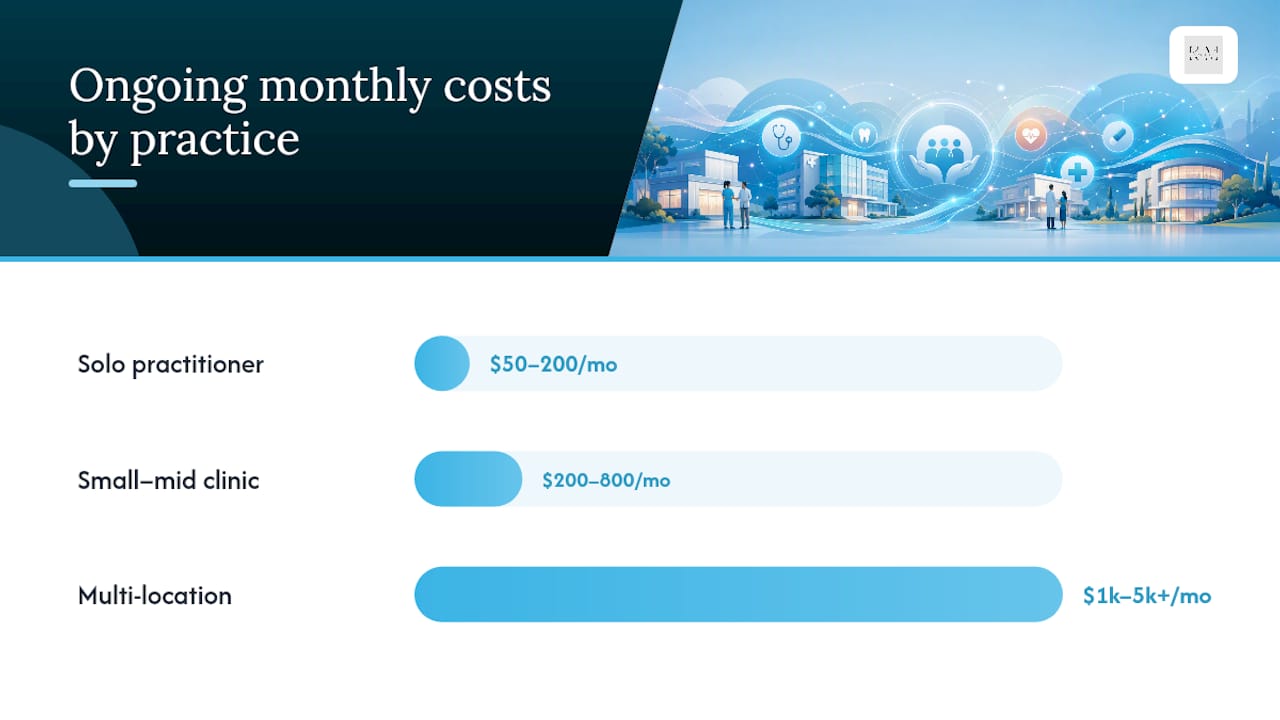
A solo practitioner site typically runs $50 to $200 a month for BAA-capable hosting, backups, and basic uptime monitoring. A small to mid-size clinic runs $200 to $800 a month once you add a modest SEO retainer and more frequent content updates. Multi-location and enterprise sites can run $1,000 to $5,000+ a month, especially with active PPC campaigns or ongoing marketing automation layered in.
What that recurring fee typically covers:
- BAA-capable hosting with encrypted backups
- Security monitoring and patching (critical for any site handling PHI)
- Plugin and platform license renewals
- An SEO retainer for local visibility and content updates
- Monitoring for EHR integration uptime, if applicable
A widely used rule of thumb: budget 15 to 25 percent of your initial build cost annually for maintenance, hosting, and ongoing optimization. On a $15,000 build, that's $2,250 to $3,750 a year, separate from any active marketing spend. Skipping this line item is how practices end up with a site that looked great at launch and feels abandoned eighteen months later. Local visibility work in particular compounds over time, which is why ongoing SEO for healthcare practices tends to pay for itself in appointment volume rather than just traffic numbers.
How Can You Cut Costs Without Cutting Compliance?
Lowering your upfront number doesn't have to mean lowering your standards. It means being deliberate about what you build now versus what you build in six months.
- Use a healthcare-specific SaaS builder for a simple launch. These run $50 to $500 a month and are fine for a solo or small practice that doesn't need deep EHR integration yet. Just confirm the vendor signs a BAA before you commit.
- Phase your rollout. Launch with a brochure site, provider bios, and a safe booking link in phase one. Add the patient portal and EHR sync in phase two, once you've validated traffic and can justify the added spend.
- Route patients through your EHR vendor's existing portal instead of building a custom one from scratch. Many EHR platforms already offer a patient-facing portal you can link to directly.
- Keep PHI off public pages entirely. The less patient data your public site touches, the less compliance infrastructure you need to build and maintain.
- Avoid generic templates the moment you're collecting patient data. Templates carry recurring platform fees and often can't sign a BAA, which turns a cheap starting point into a compliance liability.
Pro Tip: If a vendor quote seems unusually low, ask directly whether they'll sign a BAA and where patient form data is stored. A "no" to either question means the low price came from skipping the exact infrastructure that makes a healthcare site legal to run.
What Should Go in Your Website RFP?
The fastest way to get comparable quotes is to hand every vendor the same checklist before they price anything. Without it, you're comparing three different projects that happen to share a name.
Include, at minimum: provider or location count, every integration you need (EHR, scheduling, payment), whether the site collects PHI and where that data flows, how much of your content and photography is already produced, and any known accessibility requirements.
Once you have quotes back, line them up against that same checklist item by item. A quote that's 40% cheaper than the others is almost always missing something, usually compliant hosting, a BAA, or accessibility testing. Ask directly what's excluded before you assume you found a bargain.
Some agencies build specifically for independent pharmacies, medical clinics, and healthcare practices, starting from a compliance-first baseline rather than treating HIPAA as an add-on. For a rundown of the features worth prioritizing before you talk to any vendor, this guide to healthcare website features is a useful companion to your RFP.
The Real Budgeting Mistake Practices Keep Making
Most healthcare website cost guides treat compliance like a checkbox instead of the cost driver it actually is. That's backwards. The gap between a $5,000 quote and a $25,000 quote almost never comes down to design quality. It comes down to whether the cheaper vendor priced in encrypted storage, a signed BAA, and real EHR integration, or quietly left those out.
The conventional advice, "get three quotes and pick the middle one," falls apart here because the quotes usually aren't pricing the same scope. A vendor who doesn't ask about your patient data flows during the sales call almost certainly isn't planning to build for them.
If you take one thing from this article, prioritize the discovery checklist over the sticker price. A practice that scopes integrations, PHI flows, and accessibility needs before requesting bids ends up with quotes it can actually compare, and a final site it won't need to rebuild in eighteen months once compliance gaps surface.
— Opinly
Get a Healthcare Website Quote Built Around Your Actual Scope
Some agencies offer HIPAA-compliant builds as a core service for independent pharmacies, clinics, and medical practices, helping clients avoid educating vendors on BAAs or PHI handling during the project.
A discovery call typically covers the same ground as the RFP checklist above: provider count, integrations, PHI flows, and content readiness, so the quote you get back matches the project you actually need. From there, Klyrmedia scopes design, development, and any EHR or portal work around your compliance requirements from day one, with ongoing SEO and marketing automation available once the site is live. Start with the HIPAA-compliant website design service page to see what's included and request a scoped quote for your practice.
Sources
- Healthcare & Medical Website Design Cost 2026: Real Price Ranges
- Medical Website Cost: Complete Pricing Guide ($500-$150K)
- How Much Does a Professional Medical Website Cost in 2026? Complete Pricing Guide for Healthcare Websites
- MedlinePlus — Secure websites & patient privacy (patient instructions)
FAQ
How Much Does a Healthcare Website Cost?
Most healthcare websites cost between $3,000 and $75,000. Solo practices typically pay $3,000 to $8,000, small to mid-size clinics pay $8,000 to $20,000, and multi-location or hospital systems pay $30,000 to $75,000 or more depending on integrations.
Is $1,000 a Good Price for a Healthcare Website?
$1,000 is well below what a compliant healthcare website costs to build correctly. At that price point, you're almost certainly getting a bare template with no BAA-capable hosting, no accessibility testing, and no real compliance infrastructure for handling patient data.
Is $1,500 a Good Price for a Healthcare Website?
$1,500 still falls short of what a HIPAA-safe build requires once you factor in compliant hosting, encrypted forms, and basic accessibility work. It may cover a bare-bones brochure site for a solo provider that collects no patient data at all, but anything involving forms or booking needs more budget.
What Makes Medical Website Redesign Cost More Than a New Build?
A medical website redesign cost often exceeds a fresh build because agencies have to audit existing content, migrate data safely, and fix compliance gaps in the old site before adding new features. Expect redesign quotes to land in the same $8,000 to $30,000 range as a mid-size clinic's initial build, sometimes higher if the old site collected PHI without proper safeguards.
How Much Does the US Healthcare System Cost, and How Does That Relate to Website Budgets?
US healthcare spending overall runs into trillions of dollars a year at the national level, but that macro figure has little bearing on an individual practice's website budget. Practice-level web costs are driven by provider count, integrations, and compliance needs, not by broader healthcare spending trends.