

Attracting new patients is expensive. Really expensive. Patient acquisition can cost anywhere from five to twenty-five times more than keeping the patients you already have. Yet most independent clinics and pharmacies keep pouring their budget into acquisition alone, treating retention like an afterthought. That's a costly leak in your practice's growth engine. This guide walks you through a structured lead generation approach built for independent healthcare providers, covering the tools, tactics, and metrics that actually move the needle on both patient acquisition and long-term retention.
Table of Contents
- Assessing your lead generation readiness
- Step-by-step strategies for medical lead generation
- Common mistakes and troubleshooting
- Measuring results: How to verify and improve your lead generation efforts
- A fresh take: Why retention-focused lead generation is the real game changer
- Next steps: Unlocking growth with expert solutions
- Frequently asked questions
Key Takeaways
| Point | Details |
|---|---|
| Retention saves money | It costs much less to retain existing patients than to acquire new ones. |
| Actionable lead strategies | Applying digital and referral-based steps boosts patient inquiries and retention. |
| Track key metrics | Monitoring conversion and retention rates shows your lead generation ROI. |
| Avoid common pitfalls | Mistakes like ignoring follow-up and patient satisfaction can stall your growth. |
| Expert help accelerates growth | Specialized solutions for SEO, PPC, and compliance unlock advanced results. |
Assessing your lead generation readiness
Before you run a single ad or send a single email, you need to understand where you stand. Lead generation for medical practices is not just about getting names in a database. It's the full system that attracts potential patients, earns their trust, and converts them into loyal, returning visitors.
Think of it as a pipeline. If there are holes in that pipeline, spending more on advertising just pours more water into a leaking bucket.
Start with this quick readiness checklist:
- Do you have a professional, mobile-optimized website that loads in under three seconds?
- Can patients book appointments online, or do they have to call?
- Do you maintain a patient database with contact history and visit records?
- Are you capturing new patient inquiries from every channel: phone, web form, social, and walk-in?
- Do you have any automated follow-up in place after a first visit?
If you answered "no" to two or more of those, you have infrastructure gaps that will limit every lead generation effort you make. Website optimization for healthcare is often the fastest fix, followed closely by fixing your booking flow. For pharmacies specifically, website optimization strategies for pharmacy sites address the unique service mix that general healthcare sites miss.
Here's a clear breakdown of the cost and impact difference between acquisition and retention:
| Factor | New patient acquisition | Existing patient retention |
|---|---|---|
| Relative cost | 5 to 25x higher | Low, mostly operational |
| Conversion likelihood | 5% to 20% | 60% to 70% |
| Revenue predictability | Inconsistent | Steady and compounding |
| Word-of-mouth potential | Low at entry | High after trust builds |
| Marketing channel needed | Paid ads, SEO, outreach | Email, SMS, loyalty programs |
The pattern is clear. Retention is where data-driven health practices are finding their highest return. Yet most independent practices spend the bulk of their marketing budget chasing cold leads.
Common areas that typically need improvement in independent practices:
- No clear call-to-action on the homepage
- Outdated or missing Google Business Profile information
- No system to follow up with patients who haven't returned in 90 or more days
- Inconsistent or absent review generation process
- No segmentation between new patient outreach and current patient communications
Getting these fundamentals right before spending on paid media saves you a lot of frustration and wasted budget.
Step-by-step strategies for medical lead generation
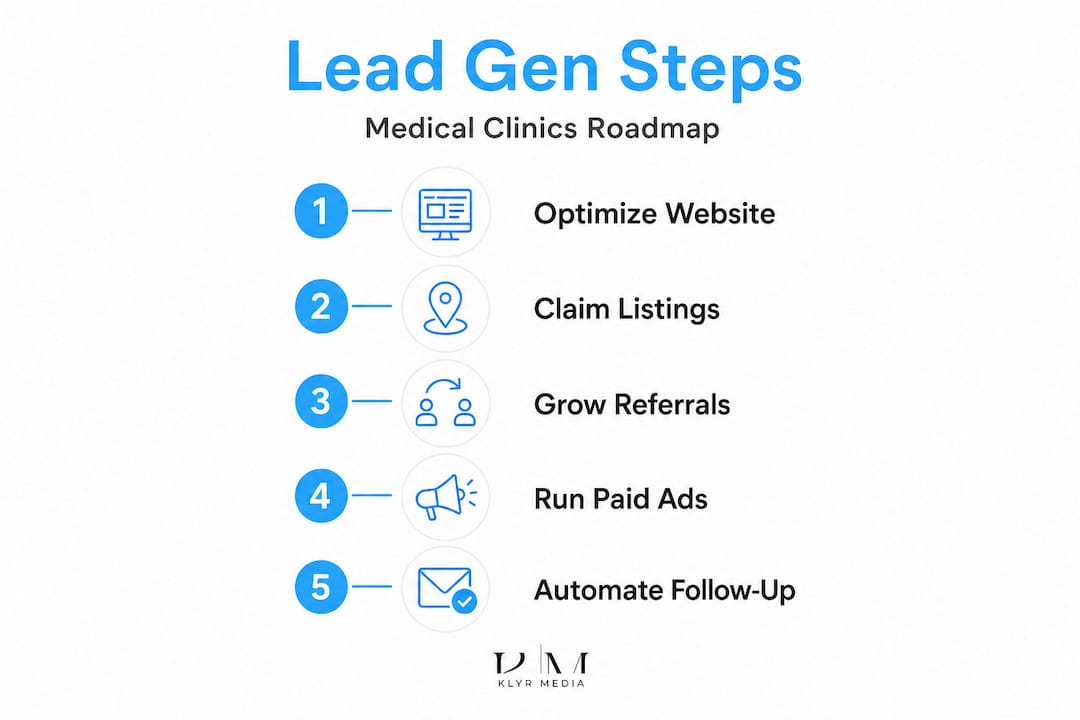
Now that you know what you have and what you need, here's how to put lead generation strategies into practice. These steps are ordered intentionally. Each one builds on the last.
1. Optimize your digital front door
Your website is not just a brochure. It's your primary lead capture tool. Make sure every page has a clear next action: book an appointment, call the clinic, or request more information. Use location-specific landing pages if you serve multiple neighborhoods. Make sure your site passes basic healthcare SEO benchmarks so patients can actually find you when they search.

2. Claim and fully optimize your local listings
Google Business Profile is free and incredibly powerful for local patient acquisition. Fill out every field, post weekly updates, and respond to every review. This single step can meaningfully increase foot traffic from nearby patients searching for your services right now.
3. Build a referral network with local providers
Specialist-to-primary care referrals, pharmacy-to-clinic referrals, and even fitness or wellness partnerships are underused channels for independent practices. A simple follow-up letter or email introduction to nearby providers can open a steady stream of warm referrals that cost almost nothing to maintain.
4. Run targeted paid ads for high-intent searches
Paid search advertising, when done right, puts your practice in front of people actively looking for care. Learning how to optimize Google Ads for healthcare is the key to avoiding wasted spend. Focus on specific services, not just your brand name, and geo-target tightly around your location.
5. Implement automated patient follow-up
Send appointment reminders, post-visit check-ins, and re-engagement messages to patients who haven't returned. These touchpoints cost almost nothing once set up, and improving retention has a direct line to improving your profitability. Even a modest improvement in retention rates compounds quickly into significant revenue gains.
6. Localize your content marketing
Write or publish content that answers the health questions your specific community is asking. A blog post about managing Type 2 diabetes in your city, or a video on flu shot availability at your pharmacy, will attract local patients far better than generic national health content. Pair this with local patient acquisition tactics for maximum geographic reach.
7. Stay compliant throughout
Every email you send, every patient form you use, and every data point you collect must adhere to HIPAA and GDPR requirements. This isn't just a legal checkbox. Patients who trust your privacy practices stay longer and refer more. Non-compliance, on the other hand, can cost your practice far more than any marketing campaign is worth.
Pro Tip: Build a simple referral card or digital referral link for your happiest patients. A satisfied patient who refers one friend has just cut your acquisition cost for that new patient to nearly zero. Automate a "thank you and refer a friend" message at the three-month mark after a patient's first visit.
Common mistakes and troubleshooting
Even with the right steps, mistakes happen. Recognizing and fixing them keeps your lead generation on track.
The most common lead generation mistakes independent practices make:
- Ignoring retention entirely. Running acquisition ads while patients quietly stop returning is like filling a tub with the drain open.
- Poor or non-existent follow-up. Most practices contact a new lead once, get no response, and move on. Studies suggest it takes five to eight touchpoints before a new patient makes an appointment.
- Not asking for reviews. Patients rarely leave reviews unless prompted. A simple text message after a visit asking for feedback is often all it takes.
- Treating all patients the same. A new patient who came in for a flu shot needs a completely different follow-up sequence than a chronic care patient managing a long-term condition.
- Neglecting the Google Business Profile. An incomplete or outdated profile loses you patients to competitors who simply took the time to fill it out properly.
- Skipping website compliance. A site that isn't optimized for patient experience and bookings is bleeding leads every single day.
Pro Tip: Set up an automated re-engagement sequence for any patient who hasn't had a visit or filled a prescription in 90 days. A short, friendly message asking how they're doing and reminding them of available services can recover a surprising number of patients who simply forgot to come back.
"Improving patient retention by just 5% can boost profits substantially, with some studies pointing to increases of 25% to 95% depending on the practice type. That's not a marketing win. That's a business transformation."
For practices serious about local visibility, fixing your Google Business Profile for clinics is one of the highest-return, lowest-cost actions you can take today.
Also worth considering: patient-centered care approaches show that when patients feel genuinely heard and supported, retention improves naturally. The clinical experience and the marketing experience need to be consistent.
Measuring results: How to verify and improve your lead generation efforts
With mistakes addressed, tracking performance ensures your lead generation continues to deliver results. You can't improve what you don't measure. Most independent practices either track nothing or track the wrong things, like social media followers instead of appointment conversion rates.
Here are the metrics that actually tell you how your lead generation is performing:
| Metric | What it tells you | Target benchmark |
|---|---|---|
| New patient conversion rate | % of inquiries that book an appointment | 20% to 40% |
| Patient retention rate | % of patients returning within 12 months | 60% or higher |
| Referral count per month | Patients sent by existing patients or partners | Track for monthly growth |
| Cost per new patient | Total marketing spend divided by new patients | Below your average lifetime value |
| Online review volume | New reviews per month | Two or more per month minimum |
| Appointment no-show rate | % of booked appointments not completed | Below 10% |
If your numbers are off, here's how to start fixing them:
- Low conversion rate: Improve your website call-to-action, simplify your booking form, and test different ad copy.
- Low retention rate: Introduce automated follow-up sequences, post-visit surveys, and loyalty communications.
- Few referrals: Activate a referral program, ask happy patients directly, and build relationships with nearby providers.
- High no-show rate: Add a 24-hour and one-hour appointment reminder via text or email.
- Low review volume: Send a polite review request message 48 hours after a successful visit.
The financial case is not subtle. Increasing patient retention by 5% has been linked to profit increases between 25% and 95%. That's not a rounding error. That's the difference between a practice that struggles and one that scales.
For paid channel performance, tracking your healthcare PPC advertising ROI separately from organic search results gives you a much clearer picture of where to increase or decrease budget. And if you're not ranking on the first page of local search results, investing in healthcare SEO services is typically the highest-leverage move you can make.
A fresh take: Why retention-focused lead generation is the real game changer
Here's something that most marketing guides won't tell you: the way most clinics think about lead generation is fundamentally backwards.
Practices treat acquisition as the goal and retention as a bonus. The math says it should be the other way around. Every retained patient is not just a repeat visit. They become a referral source, a testimonial, and a social proof signal that attracts new patients organically. Retention is lead generation. It just works on a longer timeline.
The clinics that figure this out early stop competing on ad spend and start competing on patient experience. They invest in follow-up systems. They build community. They track retention improvements as seriously as they track new patient numbers.
Most independent practices are competing with large health systems and pharmacy chains that have massive advertising budgets. You will not win that race by spending more on ads. You win it by making your patients feel like they would never go anywhere else.
Here's a contrarian perspective worth sitting with: your lead generation and your retention marketing should share the same budget conversation, not be split into separate line items. When you start looking at acquisition and retention as parts of the same growth loop, your marketing decisions get a lot smarter.
Pro Tip: Segment your marketing outreach into three groups: new prospects, patients within their first 90 days, and long-term patients. Each group needs a different message, a different tone, and a different call to action. Treating them all the same is leaving significant search and keyword opportunities on the table, along with revenue.
The practices that win in the next five years won't just be the ones with the best ads. They'll be the ones with the strongest patient relationships, the most consistent follow-up, and the clearest data showing them where to double down.
Next steps: Unlocking growth with expert solutions
You've got the framework. You know what to measure, what to fix, and where the real leverage is. The next question is whether you want to build all of this yourself or work with people who have already solved it for independent practices like yours.
At KLYR Media, we build the exact systems described in this article for independent pharmacies and medical clinics across the United States. That means healthcare SEO strategies that rank you where local patients are searching, healthcare PPC campaigns that generate appointments without wasted ad spend, and HIPAA-compliant website design that converts visitors into patients while keeping your practice protected. If you're ready to stop guessing and start growing, let's talk about what a real lead generation system looks like for your practice.
Frequently asked questions
What is the most cost-effective way to generate leads for a medical practice?
Focusing on patient retention and referral programs is typically the most cost-effective approach, since acquisition costs run 5 to 25x higher than keeping an existing patient engaged and returning.
How can I improve retention rates in my clinic?
Delivering an excellent patient experience combined with consistent, automated follow-up communications is the most reliable path, since retention improvements have a direct and measurable impact on practice profitability.
What metrics should I track to measure lead generation success?
Track conversion rates, patient retention percentages, monthly referral counts, and online inquiry volume, keeping in mind that a 5% retention increase can improve profits by as much as 95% in some practice types.
Are there compliance considerations for digital lead generation?
Yes, absolutely. All digital marketing activities, patient data collection, and follow-up communications must comply with HIPAA regulations and applicable privacy laws to protect both your patients and your practice license.
Recommended
- How to Promote Your Healthcare Clinic Location: Local Patient Acquisition Strategies | Blog
- Healthcare PPC Advertising | Pharmacy & Medical PPC Management | KLYR Media
- Best Keywords to Use for Healthcare Marketing: Patient Acquisition Search Terms | Blog
- How to Optimize Google Ads for Healthcare: HIPAA-Compliant Patient Acquisition | Blog