

If your locator runs on a single map widget and one URL, fix that first: build a crawlable HTML page for every location, load it with LocalBusiness or Pharmacy schema, and match the name, address, and phone number exactly to your Google Business Profile. Add clear service lists and real internal links between locations. Then make sure every page sits in your sitemap, links from a region or hub index, and gets checked in Search Console until it's confirmed indexed.
TL;DR:
- Building a crawlable, indexed location page with accurate NAP, service lists, and schema increases visibility in local searches and attracts traffic ready to convert.
- Replacing JavaScript widgets with server-rendered pages, automating sitemaps, and adding internal links from high-performing pages fixes indexing issues and improves ranking.
- Every store requires a unique URL with specific content, local schema, and consistent NAP to avoid suppression due to mismatches and ensure Google understands its relevance.
- Optimizing Google Business Profile with accurate categories, photos, attributes, and linking directly to location pages enhances local pack ranking.
- Regularly tracking impressions, clicks, directions, and reviews, along with timely response and citation audits, is vital for maintaining and growing local SEO performance.
Table of Contents
- Why Pharmacy Store Locator SEO Actually Moves Revenue
- What Breaks Locators: Iframes, JS Widgets, and the Single-URL Trap
- The Location Page Checklist: What Every Store Needs Live Right Now
- Does Your Google Business Profile Match What's Actually True?
- Which Keywords Actually Win for Independent Pharmacies?
- How Should You Structure Links So Google Finds Every Store?
- What Should You Track Once the Pages Are Live?
- How Do You Handle Reviews Without It Becoming a Second Job?
- Do Citations Beyond Google Business Profile Still Matter?
- Is Your Location Page Fast Enough on a Phone?
- Can Local Events and Health Topics Drive Real Locator Traffic?
- The Compliance-First Approach to Store Locator SEO
- Ready to Fix Your Locator? Here's Where Klyrmedia Fits
- Sources
- FAQ
Why Pharmacy Store Locator SEO Actually Moves Revenue
Here's the part chains hope you never figure out: 46% of all Google searches carry local intent, and pharmacies that land in the local 3-pack pull noticeably more traffic than the ones buried below it. That traffic isn't abstract. It's someone typing "pharmacy that does travel vaccines near me" at 9 p.m., ready to walk in tomorrow.
A locator built as real, indexed pages lets you compete for exactly those searches. Chains often skip service-specific and condition-specific queries because their locator tech can't support them at scale. That gap is yours to take. A single well-built location page, matched to a real service like compounding or immunizations, can quietly out-rank a page from a national chain that never bothered to build one.
What Breaks Locators: Iframes, JS Widgets, and the Single-URL Trap
Most broken locators share one root cause: a JS-only map or iframe renders every location inside one page, so Google sees exactly one indexable URL no matter how many stores you have. Search a city name plus "pharmacy," and that page has nothing unique to rank with. The map looks great to a human. Googlebot mostly can't use it.
Here's how to unwind that:
- Replace the widget with server-rendered pages. Every location gets its own URL with real HTML content, not a JavaScript render Google has to guess at.
- Automate the sitemap. New locations should push into the XML sitemap the moment they go live, not weeks later during a manual audit.
- Use progressive enhancement. Keep the interactive map for users, but load a plain HTML list of locations underneath it so crawlers always have something to read.
- Rebuild internal links. Add contextual links from blog posts, service pages, and the main nav straight into each location page.
- Recheck index status. Pull up Search Console weekly until every page shows "Indexed," not "Discovered, currently not indexed."
Pro Tip: A page stuck in "Discovered, currently not indexed" almost never gets fixed by resubmitting the sitemap again. It gets fixed by linking to it from a page that already earns impressions.
The Location Page Checklist: What Every Store Needs Live Right Now
This is the part your developer can build from directly. Every store needs its own unique URL, no exceptions, with LocalBusiness or Pharmacy schema carrying geo-coordinates, openingHoursSpecification, a url field pointing to itself, and a breadcrumb list so Google understands where the page sits in your site.
The content on the page matters just as much as the code behind it:
- Exact NAP that's byte-identical to your Google Business Profile listing, down to "St." versus "Street"
- Direct phone number and current hours, not a placeholder that hasn't been updated since a shift changed
- A real list of services available at that specific site: immunizations, compounding, medication synchronization, whatever actually applies
- A pharmacist bio and photo for that location, not a stock corporate headshot
- Parking, access notes, and a nearby landmark or two for people driving in from unfamiliar neighborhoods
- Links to the two or three nearest sister locations
Sitemap and internal linking rules matter here too. Keep a Locations hub in your main navigation or footer, and if you're running more than a handful of stores, add a region or state tier so link value doesn't get diluted across dozens of flat pages. Every location page should also collect contextual inbound links from pages already earning search impressions, not just from the hub itself.
Pro Tip: Byte-identical NAP is not a suggestion. A mismatch as small as "Suite 4" versus "(Suite 4)" can be enough for Google to treat two listings as inconsistent and quietly suppress local visibility.
Does Your Google Business Profile Match What's Actually True?
A fully built-out Google Business Profile remains the single most direct lever on local pack placement, and most pharmacies leave it half finished. Start with categories: primary category should be Pharmacy, but don't skip secondary categories for services you actually run, like compounding pharmacy or vaccination clinic.
From there, work through the fields that keep GBP and your website in sync:
- NAP that matches your location page exactly, character for character
- Real photos of the storefront, staff, and interior, refreshed at least quarterly
- Attributes turned on where true: delivery available, wheelchair accessible, LGBTQ friendly
- Service listings that mirror what's on the location page, not a generic template
- GBP Posts published regularly, tied to flu season, back-to-school vaccines, or local health events
- Timely responses to every review, good or bad
Every verified GBP profile should link straight to its matching location page, and that page should reflect exactly what happens at that address. Our guide to optimizing Google Business Profile for pharmacies walks through the field-by-field setup if you want the longer version.
Which Keywords Actually Win for Independent Pharmacies?
"Pharmacy near me" is a battle you're not winning against three national chains with unlimited marketing budgets. Service and condition-specific long-tail terms are where independents actually convert better, because chains rarely build pages targeting them.
Build your keyword map this way:
- Assign one primary keyword per page. "Compounding pharmacy in [neighborhood]" or "flu shot walk-in [city]" beats a generic term every time.
- Layer in semantic variants. Add related phrases naturally throughout the page copy, not stuffed into one paragraph.
- Write three to five FAQs per location. Real questions people ask at the counter, wrapped in FAQPage schema.
- Add a pharmacist-authored trust element. A short note from the pharmacist on staff signals real expertise, not template copy.
- Keep it lean. A tight 300 to 500 words of content unique to that location beats a padded 1,500-word page copied across ten stores.
Our keyword guide for pharmacy marketing has a prioritization template if you're mapping this across a multi-location estate.
How Should You Structure Links So Google Finds Every Store?
Sitemaps tell Google a page exists. Internal links tell Google the page matters, and that distinction decides whether your locations actually get indexed.
- Build a Locations hub, linked from your main nav or footer, that lists every store
- Add region or city tiers once you're past roughly 50 locations, so link equity doesn't thin out
- Target three to four internal links pointing into every location page, with at least two coming from pages that already earn search impressions
- Recheck index status at day 14, then again at day 30, and add more contextual links to anything still stuck
Pro Tip: A blog post about seasonal allergies that already ranks is a better internal link source than your homepage. Link from where the traffic already is.
What Should You Track Once the Pages Are Live?
Building the pages is half the job. Watching what happens next is the other half, and most pharmacies stop right when the real work starts.
Track these numbers weekly or monthly, not once a quarter:
- Google Maps impressions and clicks per location, pulled from GBP Insights
- Local organic clicks and phone calls, tracked through GA4 events
- Direction requests, a strong proxy for foot traffic intent
- Rank position for your target long-tail queries, checked with a rank tracker
- Prescription-transfer conversions tied back to a specific location page
With 46% of Google searches carrying local intent, a location page that isn't indexed is invisible to nearly half your potential search traffic. Set a cadence: weekly GBP checks, monthly NAP audits across every directory listing, and a quarterly review of schema markup and page speed. Our step by step local SEO guide for healthcare providers breaks this cadence down further if you want a calendar to hand your team.
How Do You Handle Reviews Without It Becoming a Second Job?
Reviews decide whether someone walking past three pharmacies picks yours, and they factor directly into local ranking. Ignoring them is the single fastest way to lose ground to a chain location with a mediocre product but an active review response habit.
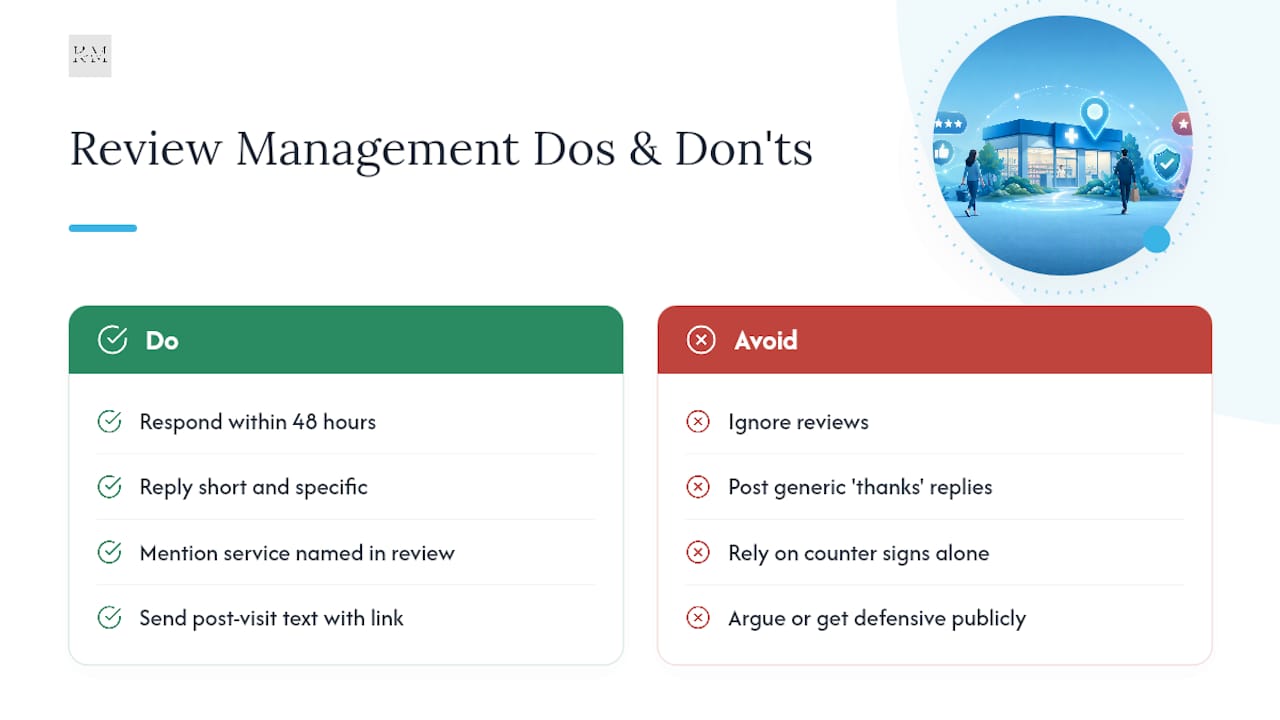
Respond to every review within 48 hours, positive or negative. A short, specific reply beats a generic "thanks for your feedback" every time; mention the service if the review names one, like a flu shot or a med sync consultation. For negative reviews, acknowledge the issue plainly, move the conversation offline with a phone number or email, and never get defensive in public. Google and patients both read tone, not just star counts.
Make asking for reviews part of the actual workflow, not an afterthought. A quick text after a prescription pickup or vaccination appointment, with a direct link to your GBP review form, works far better than a sign taped to the counter that nobody notices. Train staff to mention it naturally: "If we made this easy today, a quick review helps other folks in the neighborhood find us."
Watch for patterns, too. If five reviews in a month mention long wait times at one specific location, that's operational feedback disguised as a ranking signal. Fix the wait time, and the reviews usually follow. Reputation management for a pharmacy isn't really about optics. It's an early warning system for what's actually happening on the floor.
Do Citations Beyond Google Business Profile Still Matter?
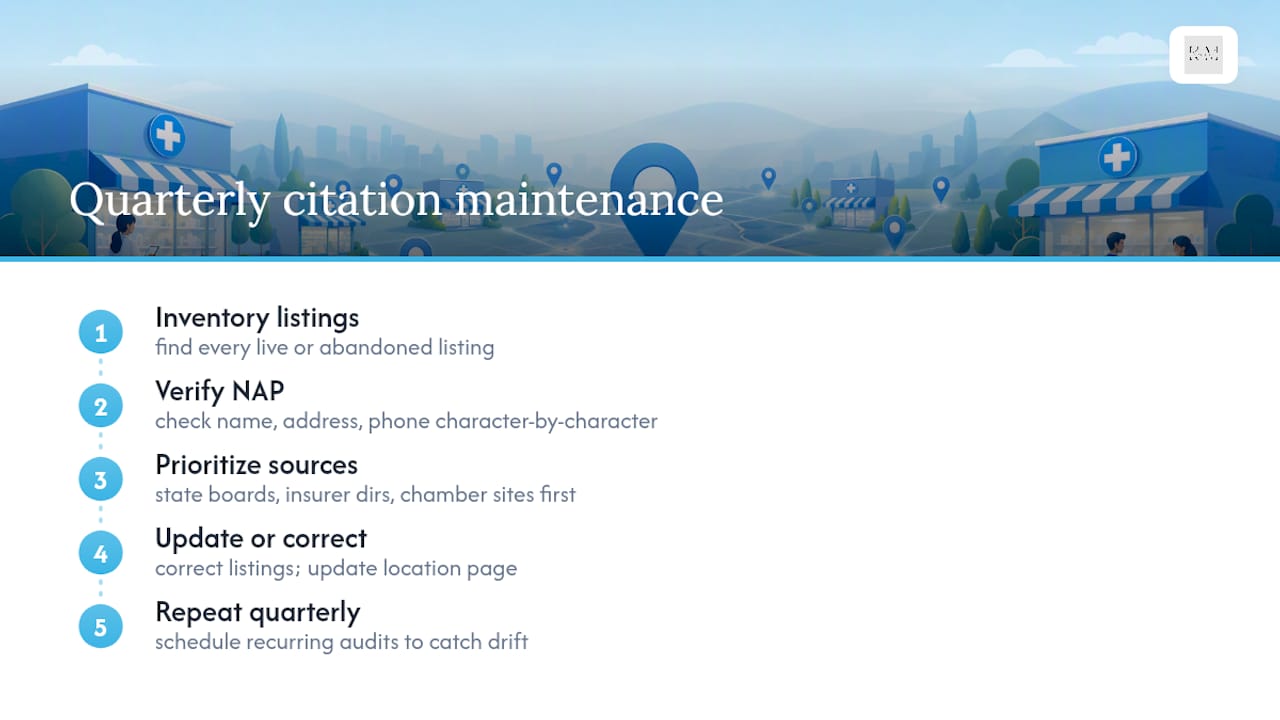
They do, and most independents under-invest here while over-investing in GBP polish. Citations on directories like Yelp, Healthgrades, Bing Places, and pharmacy-specific listings such as GoodRx's pharmacy finder reinforce the same NAP data Google is already cross-referencing. Inconsistency across these listings is one of the more common reasons a location page underperforms despite looking technically sound.
Start with an audit. Pull every directory where your pharmacy has a listing, live or abandoned, and check name, address, and phone against your location page character by character. Old addresses from a store that moved three years ago are more common than owners expect, and each one chips away at the confidence Google places in your current NAP.
Prioritize directories with real authority: state pharmacy board listings, health insurance provider directories, and local chamber of commerce sites carry more weight than low-traffic aggregator sites nobody visits. A citation on a directory insurance companies actually reference for network verification does more for trust than ten citations on sites with no real users.
Treat this as quarterly maintenance, not a one-time project. New pharmacy locations get scraped into directories automatically sometimes, and not always accurately. A recurring citation audit catches drift before it costs you a ranking position you already earned.
Is Your Location Page Fast Enough on a Phone?
Most patients finding your pharmacy are doing it on a phone, standing in a parking lot or scrolling between errands, and a slow-loading location page loses them before they see your hours. Page speed and mobile usability aren't secondary concerns for a locator. They're the first filter between a click and a bounce.
Strip location pages down to what matters: compressed images, no auto-playing video, and a map embed that loads after the core content, not before it. A pharmacist photo and a service list should render before any decorative element does. Test every location page on an actual phone, not just a desktop browser resized smaller, because touch targets, font size, and click-to-call buttons behave differently than they look in a simulator.
Click-to-call is not optional for a pharmacy location page. Someone checking if you're open or if you carry a specific medication wants to tap a number, not hunt for it in a footer. Same logic applies to directions: a one-tap link into Google Maps or Apple Maps beats a typed address every time.
Our website optimization guide for pharmacies covers the technical side of this in more depth, including the specific speed fixes that tend to matter most for location-heavy sites.
Can Local Events and Health Topics Drive Real Locator Traffic?
Community relevance is exactly what Google has said it wants more of for local health services, rewarding pharmacies that demonstrate real local engagement over pages that read like generic templates. That's an opening independents are built for and chains structurally aren't.
Tie content to what's actually happening nearby. A back-to-school immunization push in August, a flu shot clinic timed to a local health fair, or a diabetes management seminar hosted at the store all generate content that's genuinely local, not manufactured for SEO. Publish a short page or blog post about each event, link it to the relevant location page, and let the pharmacist's name be attached to it directly.
Seasonal health topics work the same way. A short piece on managing seasonal allergies, timed to when pollen counts spike in your region, linked from the location page serving that area, does double duty: it's useful to a real patient and it's exactly the kind of contextual internal link that helps Google find and trust your location pages. This is content marketing that never has to feel like marketing, because it's answering a question your neighbors are actually asking that week.
The Compliance-First Approach to Store Locator SEO
A recommended process is to run an audit, then technical fixes, followed by Google Business Profile sync, localized content, and measurement, repeated regularly rather than treated as a one-time project. Working exclusively with healthcare providers means every recommendation gets weighed against HIPAA-aware handling of patient-facing pages, not bolted on after the fact....
— Opinly
Ready to Fix Your Locator? Here's Where Klyrmedia Fits
This healthcare-specialist alternative to a generic marketing agency focuses on pharmacy store locator SEO, addressing compliance and technical realities pharmacies face that general SEO shops may miss.
If everything in this guide sounds right but your team doesn't have a developer free to rebuild location pages, sync schema, and monitor indexing every week, that's precisely the gap Klyrmedia's Healthcare SEO Service is built to close. The work includes technical audits, location-page builds, Google Business Profile synchronization, and ongoing monitoring, tailored specifically to pharmacies rather than via generic local SEO strategies. For stores still running on a locator that can't support real HTML pages, the HIPAA Web Design Service rebuilds the foundation properly, with compliance handled from the first line of code. If you're ready to see where your current locator is losing indexation or ranking, request an audit and get a clear picture of what's fixable this quarter.
Sources
FAQ
What Are the Big Three Pharmacy Chains?
CVS, Walgreens, and Rite Aid are typically named as the largest US retail pharmacy chains by store count and revenue. Independent pharmacies compete with them locally not on scale, but on service-specific search terms and community trust the chains rarely optimize for.
What Is the Best Store Locator Plugin for WordPress?
There's no single universal answer, since the right plugin depends on how many locations you manage and whether you need schema markup built in automatically. Whatever plugin you choose, verify it generates a unique, crawlable HTML page per location rather than rendering everything through JavaScript inside one URL, since that single-URL pattern is what most commonly blocks indexing.
What Is the Best Location for a Pharmacy?
The strongest locations combine high foot traffic with proximity to complementary healthcare services, like medical offices, urgent care centers, or grocery stores with regular repeat visits. Online, the equivalent is a location page that ranks for the specific services available there, since local intent searches drive a large share of the traffic that turns into an actual visit.
Which Software Is Used in Retail Pharmacies?
Pharmacy management platforms typically handle prescription processing, inventory, and insurance claims, and vary widely by pharmacy size and chain affiliation. For pharmacies looking to unify that operational software with patient-facing marketing and online systems, Klyrmedia offers pharmacy management and inventory solutions built for independent operators.
How Long Does It Take for a New Location Page to Get Indexed?
Most pages that follow proper internal linking and sitemap practices get indexed within two to four weeks, though pages relying only on a sitemap often stall in a "discovered, not indexed" state. Adding contextual internal links from pages that already earn impressions is the most reliable fix when a page is stuck past that window.