

Most healthcare business owners assume that running digital ads works the same way across every industry. Pick your audience, set a budget, write some copy, and watch the patients roll in. If only it were that simple. Healthcare advertising carries a weight that selling shoes or software never will. You're dealing with people's health decisions, sensitive personal data, and a regulatory environment that can turn a well-meaning campaign into a compliance nightmare overnight. This guide cuts through the confusion, explains what targeted healthcare advertising actually means, and shows you how to use it to grow your practice ethically and effectively.
Table of Contents
- What is targeted healthcare advertising?
- Why federal regulation shapes targeted healthcare ads
- How targeting works: Tools, data, and patient personas
- Best practices for ethical and effective patient acquisition
- A smarter approach to targeted healthcare advertising: What most get wrong
- Get expert help with compliant, results-driven healthcare advertising
- Frequently asked questions
Key Takeaways
| Point | Details |
|---|---|
| Know your audience | Target patient groups based on their real healthcare needs, not just broad statistics. |
| Comply with regulations | Follow both FTC and HIPAA rules for truthfulness, evidence, and data use in every campaign. |
| Use ethical targeting | Design ads that are transparent, useful, and respect patient privacy to build long-term trust. |
| Audit your strategy | Regular compliance reviews keep your advertising safe and effective as laws and best practices evolve. |
What is targeted healthcare advertising?
Now that we've surfaced the confusion, let's clarify what targeted healthcare advertising truly means.
Targeted healthcare advertising is not just about showing ads to people in a certain zip code or age bracket. It means delivering specific, relevant messages to well-defined patient segments based on real health needs and medically meaningful criteria. The difference between general targeting and healthcare targeting is significant, and getting it wrong has real consequences.
Think about it this way. A shoe brand can target "women aged 25 to 45 who like running." That's fine. But a medical clinic targeting "adults with Type 2 diabetes seeking insulin management" is operating in a completely different legal and ethical space. Patient privacy expectations are higher. The emotional stakes are higher. And the regulatory standards are higher.
Common targeting variables in healthcare include:
- Age and life stage (pediatric patients vs. seniors managing chronic conditions)
- Geographic location (targeting patients within a specific service radius)
- Chronic condition or treatment interest (diabetes care, weight management, allergy treatment)
- Insurance type (Medicare, Medicaid, or specific commercial plans)
- Behavioral signals (searching for a new primary care provider, recently moved to the area)
Understanding HIPAA and GDPR is foundational here. These frameworks shape what data you can use and how you can use it. And beyond privacy law, the FTC requires that health ads be truthful, substantiated by scientific evidence, non-deceptive, and accompanied by clear disclosures. That applies even to businesses that aren't traditional HIPAA-covered entities.
Choosing the right best keywords for healthcare marketing is part of this too. Your targeting starts before someone even clicks your ad. It starts with what they're searching for and whether your message matches their real need.
Why federal regulation shapes targeted healthcare ads
Understanding the definition, we have to ask: what makes healthcare advertising different legally?
The short answer is that healthcare touches on some of the most sensitive personal information in existence. Federal regulators take that seriously. Two major frameworks govern the space, and they operate differently.
| Factor | FTC Rules | HIPAA |
|---|---|---|
| Who it applies to | Any business making health-related claims, including non-covered entities | Covered healthcare entities and their business associates |
| Core focus | Truthful, evidence-backed advertising; fair data practices | Patient data privacy and security |
| Enforcement mechanism | Civil penalties, ad takedowns, consent orders | OCR investigations, fines up to $1.9M per violation category |
| Applies to ad targeting | Yes, including data sharing practices | Yes, when PHI is involved in targeting |
| Disclosure requirements | Yes, clear and conspicuous | Yes, for authorization and data use |
The FTC's reach is broader than many providers realize. Even if your practice is not a HIPAA-covered entity, you are still subject to FTC enforcement if your health data is analyzed or used in ways that are deceptive or unfair. That includes how you share data with ad platforms, what claims you make in your ads, and whether your disclosures are visible and honest.
Key takeaway: In healthcare advertising, the FTC requires that every health claim be truthful and backed by scientific evidence. Non-deceptive messaging and transparent disclosures are not optional extras. They are the baseline. And the rules apply whether or not you're covered by HIPAA.
Real consequences exist for getting this wrong. Ad takedowns are the least painful outcome. Fines, consent orders, and public enforcement actions can damage your reputation and your bottom line in ways that take years to recover from. One regional telehealth company learned this the hard way when its targeted ad campaign made unsubstantiated weight loss claims. The FTC investigation that followed resulted in a consent order, mandatory ad revisions, and ongoing compliance monitoring.
When you're using Google Ads for healthcare, Google itself layers on additional restrictions beyond what federal law requires. Certain health conditions cannot be used as targeting criteria within the platform. Understanding both the legal and platform-level rules is essential before you spend a dollar.
Your data privacy regulations guide should be a living document, not something you read once and file away. Regulations evolve, and enforcement priorities shift. Staying current is not a one-time task.
How targeting works: Tools, data, and patient personas
With compliance in mind, what does effective and responsible targeting look like in practice?
The good news is that compliant targeting is still powerful targeting. You just have to be intentional about the tools you use and the data you rely on.

Common advertising tools in healthcare include Google Ads, Meta (Facebook and Instagram), programmatic display networks, and healthcare-specific platforms. Each has different capabilities and different compliance implications.
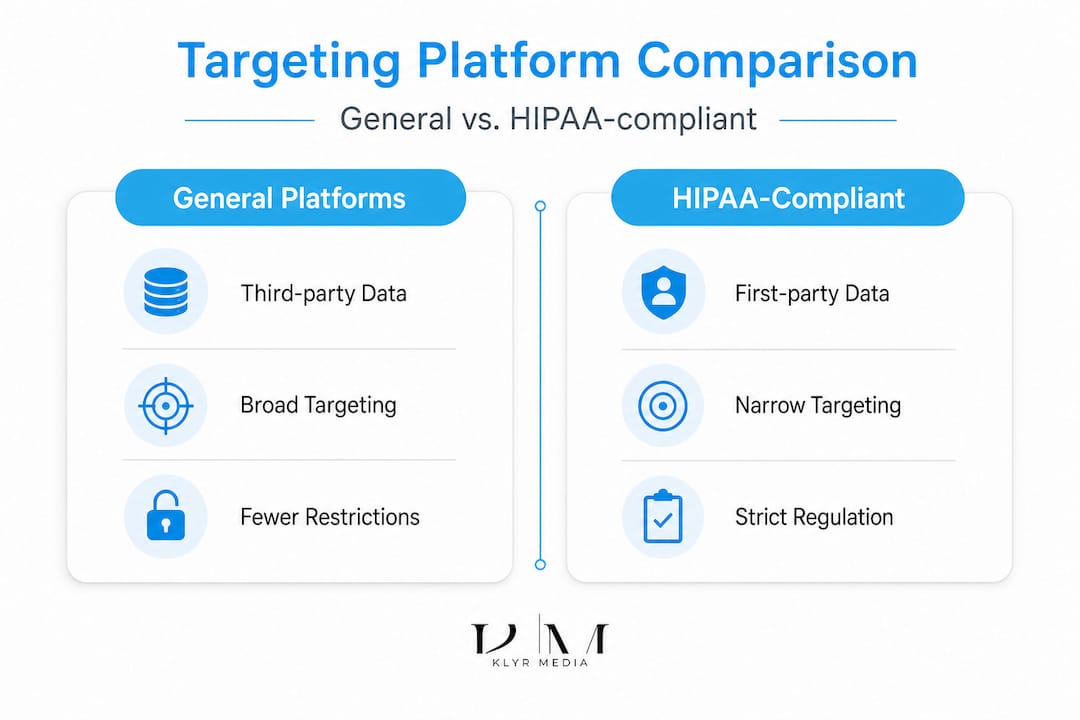
| Feature | General digital ad platforms | HIPAA-compliant targeting platforms |
|---|---|---|
| Data sources | Third-party cookies, behavioral data, interest categories | First-party patient data with proper authorization |
| Health condition targeting | Limited or prohibited | Available within compliance frameworks |
| Data sharing with ad networks | Standard (may violate HIPAA) | Controlled, with BAAs in place |
| Retargeting capabilities | Broad, cookie-based | Restricted to compliant identifiers |
| Compliance documentation | Minimal | Required, auditable |
The distinction matters. General platforms like Meta have faced significant regulatory scrutiny for how health-related data flows through their ad systems. Key insights on health data tracking show that the way data is collected and used in advertising is under more scrutiny than ever before. Using a platform without understanding its data-sharing practices is a liability.
Building a patient persona the right way is a process, not a shortcut. Here's how to do it legally and effectively:
- Start with first-party data. Use anonymized, aggregated insights from your own patient population, with proper consent and authorization in place.
- Identify medically relevant segments. Focus on conditions, treatment interests, or service needs that your practice is equipped to address.
- Map the patient journey. Understand where your ideal patient is in their decision process. Are they newly diagnosed? Looking for a second opinion? Searching for a closer provider?
- Build messaging around real needs. Your ad copy should speak directly to what that patient segment is experiencing, not just what you offer.
- Review targeting criteria against compliance standards. Before launching, confirm that every targeting variable and every piece of ad copy meets FTC and platform-specific requirements.
- Document everything. Keep records of your targeting decisions, data sources, and compliance reviews. This protects you if questions arise later.
Pro Tip: Create a simple compliance checklist that runs parallel to your campaign setup process. Before any ad goes live, every item on that checklist should be verified. Include items like: "Is this health claim backed by scientific evidence?", "Are disclosures visible and clear?", and "Does our data source have proper authorization?"
When setting up Google Ads for medical practices, the persona-building process directly informs your keyword strategy, ad copy, and landing page design. These elements need to work together. A compliant ad that leads to a non-compliant landing page is still a problem.
Relying on third-party data without verification is one of the most common mistakes we see. Data brokers sell audience segments labeled as "health-conscious consumers" or "chronic condition sufferers." These labels are not regulated. You have no way of knowing how that data was collected or whether the people in that segment consented to being targeted with health-related advertising. That's a risk not worth taking.
Best practices for ethical and effective patient acquisition
To put this all together, let's focus on proven approaches for sustainable, ethical patient growth.
Ethical targeting and effective targeting are not in conflict. In fact, the most effective healthcare ad campaigns we've seen are the ones that take compliance seriously from the start. Here's what that looks like in practice.
Do:
- Use first-party data with proper consent and authorization
- Back every health claim with verifiable scientific evidence
- Include clear, conspicuous disclosures in all ad creative
- Align your ad messaging with the actual services you provide
- Follow up compliant ad clicks with a patient experience that delivers on your promises
- Conduct regular audits of your targeting criteria and ad content
- Work with legal or compliance counsel when launching new campaigns
Don't:
- Make before-and-after health claims without rigorous evidence
- Use sensitive health conditions as targeting criteria on platforms that prohibit it
- Share patient data with ad networks without a Business Associate Agreement (BAA) in place
- Run retargeting campaigns based on health-related website visits without proper consent mechanisms
- Ignore platform-specific restrictions just because federal law doesn't explicitly prohibit something
Connecting your targeting to real patient needs is where the magic happens. An ad that speaks directly to a patient's situation, "Managing your A1C and looking for a pharmacy that actually has time for you," performs better than a generic "Visit our pharmacy today" message. And it performs better because it's more relevant, not because it's louder.
The follow-up matters just as much as the click. A patient who clicks your ad and books an appointment is only halfway to becoming a loyal patient. Your healthcare website optimization directly impacts whether that first visit turns into a long-term relationship. Slow load times, confusing navigation, and missing contact information all create friction that costs you patients.
Pro Tip: Coordinate your ad campaigns with a quarterly compliance review conducted by someone outside your marketing team. Fresh eyes catch things you miss when you're deep in the day-to-day. An independent compliance review is not a sign of weakness. It's a sign of a practice that takes its responsibilities seriously.
Local patient acquisition strategies tie everything together. Targeted advertising works best when it's connected to a broader local presence strategy, including local SEO, Google Business Profile optimization, and community-based outreach. Ads bring patients to the door. Your overall presence keeps them there.
Consider this scenario: A small independent pharmacy runs a compliant Google Ads campaign targeting adults over 55 within a 10-mile radius who are searching for medication synchronization services. The ad copy is clear, the claims are accurate, and the landing page is optimized. Within 90 days, they see a 34% increase in new patient consultations. More importantly, because the messaging was honest and the follow-up experience matched the promise, patient retention from that cohort runs higher than their baseline. That's what ethical targeting looks like when it works.
A smarter approach to targeted healthcare advertising: What most get wrong
With tactics covered, let's consider what too many leaders in healthcare miss about advertising in this sensitive, high-stakes field.
Here's the uncomfortable truth. Most healthcare providers treat digital advertising as a set-and-forget system. They launch a campaign, watch the clicks come in, and assume the work is done. It isn't. Not even close.
The providers who get into trouble are rarely the ones who set out to deceive anyone. They're the ones who got busy, stopped reviewing their campaigns, and let outdated claims or non-compliant targeting criteria run unchecked for months. The FTC doesn't care that you were busy. Enforcement actions don't come with grace periods.
What we see consistently is that providers underestimate the importance of patient feedback as a compliance signal. If patients are calling in confused about what your ad promised, that's a red flag. If your bounce rate on ad landing pages is high, that's a red flag. These signals tell you that your messaging isn't matching reality, and that gap is exactly where compliance problems live.
The hidden risk in healthcare advertising is not the campaign you know is problematic. It's the one you've stopped looking at. Ongoing review of your data privacy regulation insights is not optional. It's the foundation of a sustainable advertising strategy.
"In healthcare marketing, what you don't know about compliance can cost you far more than you realize."
Documented, evidence-based content is your best protection against future FTC scrutiny. If every health claim in your advertising has a corresponding piece of scientific evidence on file, and if your targeting decisions are documented and auditable, you are in a fundamentally stronger position than 90% of your competitors. That's not just a compliance advantage. It's a competitive one.
The providers who win long-term are the ones who build patient trust through consistency. Consistent messaging. Consistent follow-up. Consistent compliance. Acquisition gets patients in the door. Trust keeps them coming back.
Get expert help with compliant, results-driven healthcare advertising
Running compliant, effective healthcare advertising is genuinely complex. Between FTC requirements, platform restrictions, data privacy rules, and the need to actually grow your patient base, it's a lot to manage without the right support.
At KLYR Media, we specialize in exactly this intersection of compliance and growth for healthcare practices across the United States. Our healthcare marketing agency team builds campaigns that are designed from the ground up to meet regulatory standards while driving real patient acquisition results. From healthcare PPC services that put your practice in front of the right patients at the right moment, to HIPAA-compliant web design that converts ad traffic into booked appointments, we handle the full picture. If you're ready to stop guessing and start growing with a strategy built for healthcare, let's talk.
Frequently asked questions
What makes healthcare advertising "targeted"?
Targeted healthcare advertising means reaching specific patient groups based on medically relevant criteria like conditions, location, or healthcare needs, not just broad demographics. The FTC requires that all health-related targeting and messaging meet standards for truthfulness and non-deception.
Are there legal risks to using patient data for advertising?
Yes, using patient data unfairly or deceptively can result in FTC enforcement action, even if your practice is not covered by HIPAA. The FTC prohibits unfair practices in data sharing for any entity making health-related claims.
How can I ensure my healthcare ads are compliant?
Make sure all claims are supported by scientific evidence, be transparent with disclosures, and regularly review privacy and targeting practices against FTC guidance. The FTC's standards require clear disclosures and substantiated health claims as a baseline for any health-related advertising.
What's the difference between HIPAA and FTC rules for healthcare ads?
HIPAA covers patient privacy in healthcare settings, while FTC rules focus on truthful, evidence-backed advertising and fair use of health data for any business. As the FTC has clarified, these two frameworks overlap but serve distinct regulatory purposes, and both can apply simultaneously.
Recommended
- How to Optimize Google Ads for Healthcare: HIPAA-Compliant Patient Acquisition | Blog
- Healthcare SEO Agency | Pharmacy SEO & Medical Practice SEO | KLYR Media
- Best Keywords to Use for Healthcare Marketing: Patient Acquisition Search Terms | Blog
- Healthcare PPC Advertising | Pharmacy & Medical PPC Management | KLYR Media