

Most healthcare providers know they need to show up online. But here's what almost nobody tells you: what is healthcare SEO, and why does copying generic SEO advice from a marketing blog almost always backfire in the medical space? The stakes are higher, the rules are stricter, and Google treats your website differently because patients rely on it to make real health decisions. This guide breaks down exactly how healthcare SEO works, what makes it different, and how you can use it to bring more local patients through your door without cutting corners on compliance or trust.
Table of Contents
- Understanding healthcare SEO: what sets it apart
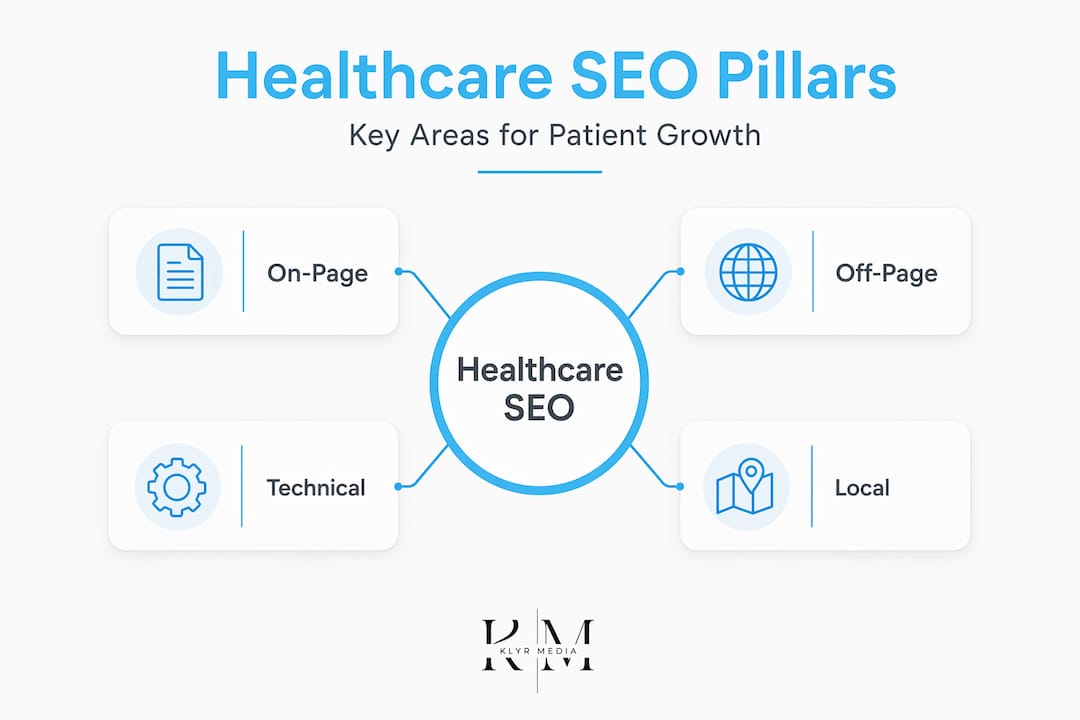
- The four pillars of healthcare SEO: on-page, off-page, technical, and local
- Why local SEO is a game changer for healthcare practices
- Building trust and compliance in healthcare SEO with E-E-A-T and YMYL
- Practical steps to implement effective healthcare SEO for your practice
- Rethinking healthcare SEO: why standard SEO advice misses the mark
- Enhance your healthcare SEO with expert, compliant digital marketing solutions
- Frequently asked questions
Key Takeaways
| Point | Details |
|---|---|
| Specialized SEO | Healthcare SEO requires tailored strategies that focus on trust and clinical expertise beyond generic SEO. |
| Four SEO pillars | Successful healthcare SEO incorporates on-page, off-page, technical, and especially local SEO for patient discovery. |
| Local SEO matters | Optimizing for local searches and managing online profiles ensures your practice connects with patients nearby. |
| E-E-A-T compliance | Meeting Google’s E-E-A-T standards with accurate, updated, and expert-reviewed content is critical for ranking. |
| Expert partnerships | Working with HIPAA-compliant healthcare marketing experts helps achieve effective SEO while maintaining trust and compliance. |
Understanding healthcare SEO: what sets it apart
Healthcare SEO is the practice of optimizing medical websites to improve visibility on search engines when patients look for medical services nearby. That sounds simple enough. But here is where most practices get burned: they treat it like regular SEO, sprinkle in some keywords, get a few backlinks, and call it done.
Google does not see it that way.
Healthcare content falls under what Google calls YMYL pages, short for Your Money or Your Life. These are pages where poor information could genuinely harm someone. Think medication dosages, treatment options, or symptoms. Because of that, Google applies much tighter quality standards to healthcare websites than it does to, say, a recipe blog or a travel site.
The framework Google uses is called E-E-A-T, which stands for Experience, Expertise, Authoritativeness, and Trustworthiness. Healthcare SEO efforts must be built around these signals, especially expertise and trustworthiness, to rank well for medical topics. That means your content needs to be written or reviewed by real clinicians, your author credentials need to be visible, and your site needs to project genuine authority.
Here is what healthcare SEO covers at a high level:
- On-Page SEO: Keyword placement, heading structure, content quality, image alt tags, and medical accuracy
- Off-Page SEO: Building citations, earning backlinks from trusted health directories, and managing patient reviews
- Technical SEO: Page speed, mobile responsiveness, site security (HTTPS), and crawlability
- Local SEO: Google Business Profile optimization, location-specific keywords, and local directory listings
Following SEO best practices matters for any website, but in healthcare, skipping the trust and compliance layers does not just hurt your rankings. It can genuinely damage the credibility patients use to decide where to seek care.
The four pillars of healthcare SEO: on-page, off-page, technical, and local
Healthcare SEO is divided into four operational areas, each with a distinct role in building your practice's online presence. Let's look at each one honestly.
| Pillar | Core Focus | Key Healthcare Priority |
|---|---|---|
| On-Page SEO | Content, keywords, structure | Clinical accuracy, author credentials |
| Off-Page SEO | Backlinks, citations, reviews | Trusted health directory presence |
| Technical SEO | Speed, mobile, crawlability | HTTPS security, structured data |
| Local SEO | Maps, local listings, geographic keywords | Google Business Profile, NAP consistency |
On-Page SEO is where most providers should start. It involves writing patient-friendly content that also satisfies Google's quality bar. That means using the right keywords naturally, adding descriptive alt text to images, structuring pages clearly, and keeping medical information current. An outdated page about a condition with old treatment guidelines is not just a trust problem. It is a ranking problem.

Off-Page SEO is about what the rest of the internet says about you. Reviews on health-specific platforms, listings in reputable directories, and mentions on local news sites all signal authority to Google. A clinic with 200 detailed reviews and consistent citations across directories looks very different to Google than one with a lonely five-review profile.
Technical SEO is the foundation nobody sees but everybody feels. A slow, mobile-unfriendly site loses patients before they even read your content. Website optimization for healthcare includes making sure your site loads in under three seconds, uses HTTPS, and is structured in a way that search engines can read without friction.
Local SEO is arguably the most valuable of the four for independent practices and clinics. Patients are not searching "best cardiologist in the world." They're searching "cardiologist near me" or "urgent care open now in [city]." Here is a quick-start approach:
- Claim and fully complete your Google Business Profile
- Make sure your practice name, address, and phone number match across every online listing
- Add location-specific service pages to your website
- Ask satisfied patients to leave reviews and respond to every one
- Build citations in healthcare-specific directories like Healthgrades, WebMD, and Zocdoc
Pro Tip: NAP consistency (Name, Address, Phone number) sounds tedious, but mismatches across even a handful of directories can quietly tank your local rankings. Audit yours at least twice a year.
Why local SEO is a game changer for healthcare practices
Let's be honest. You are not competing with Mayo Clinic for national search traffic. You are competing for the patient down the street who just searched "family doctor accepting new patients near me." That is your race. And local SEO connects practices with active nearby patients in a way no other marketing channel can match.
Here is what makes local SEO different from broader search marketing:
- It targets patients with immediate intent. Someone searching "walk-in clinic open Saturday" is ready to book.
- It reduces your patient acquisition cost. Organic local traffic costs nothing per click once you rank.
- It levels the playing field. A well-managed Google Business Profile from a small independent clinic can outrank a large health system in local map results.
- It builds credibility through reviews, which patients trust more than any advertisement.
To build your local visibility, focus on these actions:
- Keep your Google Business Profile updated with current hours, services, photos, and responses to reviews
- Use location-specific keywords on your website pages, like "pediatric care in [city name]" rather than just "pediatric care"
- Get consistent citations across directories like Yelp, Healthgrades, and your local Chamber of Commerce
- Encourage patient reviews and respond to them, even the negative ones. Engagement signals trust.
"Local SEO is not optional for healthcare providers. It is the difference between a patient calling your office and a patient calling your competitor."
New to an area or opening a second location? Local patient acquisition strategies can generate visibility almost immediately after you claim your listings and start building reviews. You do not have to wait months for results the way you might with national SEO.
Pro Tip: Add a short FAQ section to each location page on your site answering common questions like parking, accepted insurance, and appointment booking. These trigger featured snippet appearances in search results and directly answer what patients want to know before calling.
Check out our guide to finding the best healthcare marketing keywords so your location pages are actually targeting what patients search.
Building trust and compliance in healthcare SEO with E-E-A-T and YMYL
You cannot talk about healthcare SEO without going deeper on E-E-A-T and YMYL. These are not buzzwords. They are the actual criteria Google's quality raters use to evaluate whether your site deserves to rank.
YMYL means the stakes are real. Health content that is inaccurate, outdated, or written without clinical expertise can genuinely harm readers. Google knows this. Google's Search Quality Rater Guidelines make it clear that YMYL pages not meeting E-E-A-T run the risk of ranking lower. That is not a warning you can afford to ignore when a prospective patient's first touchpoint with your practice is a Google search.
Here is what demonstrating E-E-A-T actually looks like in practice:
- Visible author credentials: Every content page should list who wrote or reviewed it. "Dr. Sarah Kim, MD, Board-Certified Internal Medicine" is not just good SEO. It is good medicine.
- Regular content reviews: Medical guidelines change. A page about diabetes management written in 2022 may already be outdated. Schedule annual reviews at minimum.
- Transparent contact information: Full address, phone number, and hours on every page reinforce legitimacy.
- Clinical references: Cite medical sources. Link to peer-reviewed studies or authoritative organizations like the CDC or NIH where relevant.
"Because healthcare is YMYL, Google treats content quality failures as a ranking signal, not just a user experience problem."
Because healthcare content impacts user safety, Google gives these sites the least benefit of the doubt. One thin, uncited page with no author attribution can drag down your entire site's perceived authority.
Good editorial workflows matter here. Have a clinician sign off on each piece of content before it goes live. Keep a simple log of when each page was last reviewed. These small habits are the backbone of a site that ranks and earns patient trust simultaneously. Healthcare website optimization done right weaves compliance into every layer, not just the fine print.
Practical steps to implement effective healthcare SEO for your practice
Here is where it gets real. Knowing what healthcare SEO is only helps if you act on it. These are the steps that actually move the needle:
- Start with keyword research. Focus on patient-intent search terms tied to your specialty and location. Think "dermatologist accepting Medicare in Austin" not just "dermatologist."
- Audit your existing content. Identify pages with no author, outdated clinical information, or thin word counts. Fix those first.
- Fully optimize your Google Business Profile. Add photos, services, correct hours, and your practice description. Optimizing your Google Business Profile is one of the highest-return tasks in local SEO.
- Run a technical audit. Check page speed, mobile responsiveness, broken links, and HTTPS status. Fix critical issues before building more content.
- Build your citation profile. Submit to Healthgrades, Zocdoc, WebMD, and your state medical association directory.
- Monitor and respond to reviews. Reviews are both a local ranking signal and a patient trust signal. Do not let them sit unanswered.
Effective healthcare SEO uses targeted, specialty-specific keywords to connect with patients who are already searching for exactly what you offer. Here is a simple tracking table to help you prioritize:
| Task | Priority | Timeline |
|---|---|---|
| Keyword research | High | Week 1 |
| Google Business Profile setup | High | Week 1 |
| Technical audit and fixes | High | Weeks 1-2 |
| Content review and authorship | High | Weeks 2-4 |
| Citation building | Medium | Month 2 |
| Review management | Ongoing | Monthly |
Pro Tip: Do not try to fix everything at once. Start with your Google Business Profile and one or two core service pages. Get those right before expanding. Small wins compound fast in local SEO.
Pair your SEO work with location-specific promotion strategies and solid website optimization and you create a system that keeps working for you around the clock.
Rethinking healthcare SEO: why standard SEO advice misses the mark
Here is something most articles on this topic will not say directly. Most of the SEO content you find online was written for e-commerce stores, SaaS companies, and media sites. The advice is not wrong for those industries. But applying it directly to a medical practice is like using a restaurant's recipe for a pharmacy. Similar ingredients, completely different requirements.
Generic SEO checklists underperform in healthcare because Google rewards demonstrable clinical authorship and content maintenance as prerequisites, not afterthoughts. We have seen practices build 50-page content libraries and still rank poorly because none of it had a credited author, a review date, or a single clinical citation.
The providers who win at healthcare SEO treat it as a patient care extension. Every page they publish goes through the same care as a patient handout. Accurate. Reviewed. Attributed. That is not just good for rankings. It is what your patients deserve.
Local SEO in healthcare is also fundamentally different from local SEO for a restaurant or a retailer. The trust bar is higher. A patient choosing a primary care doctor is not picking a pizza place. Reviews carry more emotional weight, credentials matter more, and the decision takes longer. Your SEO strategy has to account for that longer trust-building arc, not just focus on clicks.
The best healthcare SEO practices always put patient well-being and compliance first. The good news? When you do it right, those priorities align perfectly with what Google rewards.
Enhance your healthcare SEO with expert, compliant digital marketing solutions
If you have made it this far, you understand how different and demanding healthcare SEO really is. Doing it right takes clinical rigor, local strategy, and technical know-how working together.
That is exactly what KLYR Media was built to handle. We specialize in healthcare SEO services that meet HIPAA standards and E-E-A-T requirements, so your practice grows its patient base without ever cutting corners on compliance. From HIPAA-compliant website design to local SEO, reputation management, and content strategy, everything is built for healthcare specifically. You are not adapting a generic agency's playbook. You are getting a system designed for your world. Explore our full healthcare digital solutions and see how we can help your practice attract more patients and keep them coming back.
Frequently asked questions
What is healthcare SEO and why is it different?
Healthcare SEO involves optimizing medical websites with a focus on trust, clinical expertise, compliance, and patient-focused content to meet the stricter standards Google applies to health-related topics. Healthcare content impacts user safety, so Google requires expertise and trustworthiness signals that most general websites simply do not need.
Why is local SEO important for healthcare providers?
Local SEO helps patients find your practice when they search for nearby care, and it directly increases relevant patient acquisition. Local SEO connects practices with active local patients, making it critical for any clinic serving a specific geographic area.
How does E-E-A-T affect healthcare SEO rankings?
E-E-A-T measures experience, expertise, authoritativeness, and trustworthiness, and Google uses these signals to evaluate whether healthcare content deserves to rank. Google's Search Quality Rater Guidelines require high E-E-A-T standards for YMYL healthcare content, meaning sites without visible credentials and clinical accuracy are at a consistent ranking disadvantage.
Can general SEO tactics be used for healthcare websites?
They can, but they consistently underperform. Healthcare SEO demands clinical validation, regular content maintenance, and regulatory compliance that generic SEO checklists simply do not account for, leaving practices with content that looks fine on the surface but fails Google's deeper quality review.