

Your healthcare website is your most effective 24/7 digital salesperson, and 75% of consumers judge your credibility based entirely on its design before they ever call your office. For independent pharmacies, medical clinics, and healthcare practices competing against large chains, that first impression is not cosmetic. It is clinical. Professional web design, the practice of building patient-centered digital experiences grounded in usability, compliance, and conversion strategy, directly determines whether a prospective patient books with you or clicks away to a competitor. The ROI on UX investment averages $100 returned for every $1 spent, a figure that reframes web design from an expense into a revenue engine.

Why invest in web design: the core benefits for healthcare providers
Professional web design does more than make your site look polished. It builds the kind of trust that converts a first-time visitor into a long-term patient.
- Patient trust and credibility. A consistent visual identity, clear service descriptions, and professional photography signal competence before a patient reads a single word. Strong brand identity woven into your site helps healthcare businesses stand out in a crowded local market.
- Reduced patient friction. When a patient can find your hours, book an appointment, or download a new patient form in under two clicks, they stay. Frictionless user journeys reduce the clicks needed to reach high-value actions like scheduling, which directly improves retention.
- Higher conversion rates. Well-designed interfaces can raise conversion rates by up to 200%, with superior UX potentially delivering a 400% increase. For a healthcare practice, that means more booked appointments from the same volume of website traffic.
- SEO performance. Google's mobile-first indexing rewards responsive, fast-loading sites. A technically sound architecture built by professionals gives your practice a structural SEO advantage over competitors running outdated templates.
- Operational efficiency. Online intake forms, automated appointment reminders, and patient portals integrated into your site reduce front-desk call volume. That frees your staff to focus on in-person care rather than administrative back-and-forth.
Pro Tip: Before your next redesign, audit your site's top five patient tasks: booking, finding hours, accessing forms, reading services, and contacting you. If any task takes more than two clicks, you are losing patients silently.
How does web design ROI show up in healthcare businesses?
The numbers are not abstract. They translate directly into appointment volume, patient retention, and marketing efficiency.
"A poor website has an invisible compounding cost: lost leads and revenue every month it's live." — Business Case for Investing in Professional Web Design
Think about what that means for a pharmacy or clinic running paid Google Ads. A one-second delay in page load reduces conversions by 7%, and pages taking five or more seconds to load can see bounce rates climb to 90%. Every dollar you spend on pay-per-click advertising is partially wasted when the landing page underperforms. A slow, confusing site does not just lose organic visitors. It inflates your cost per patient acquisition across every channel.
The long-term picture is equally compelling. Companies that prioritize design outperform S&P 500 peers by 228% over a decade. Design is not a cosmetic cost. It is a compounding business asset.
| ROI driver | What it means for your practice |
|---|---|
| UX investment return | Every $1 in UX design returns an average of $100 in value |
| Conversion rate lift | Strategic design can increase bookings by 200% to 400% |
| Page speed impact | A 1-second delay cuts conversions by 7%; 5-second load loses most visitors |
| Long-term equity | Design-led businesses outperform market peers by 228% over 10 years |
| Compounding cost of inaction | Delayed redesigns accumulate revenue loss that exceeds the cost of a new site |
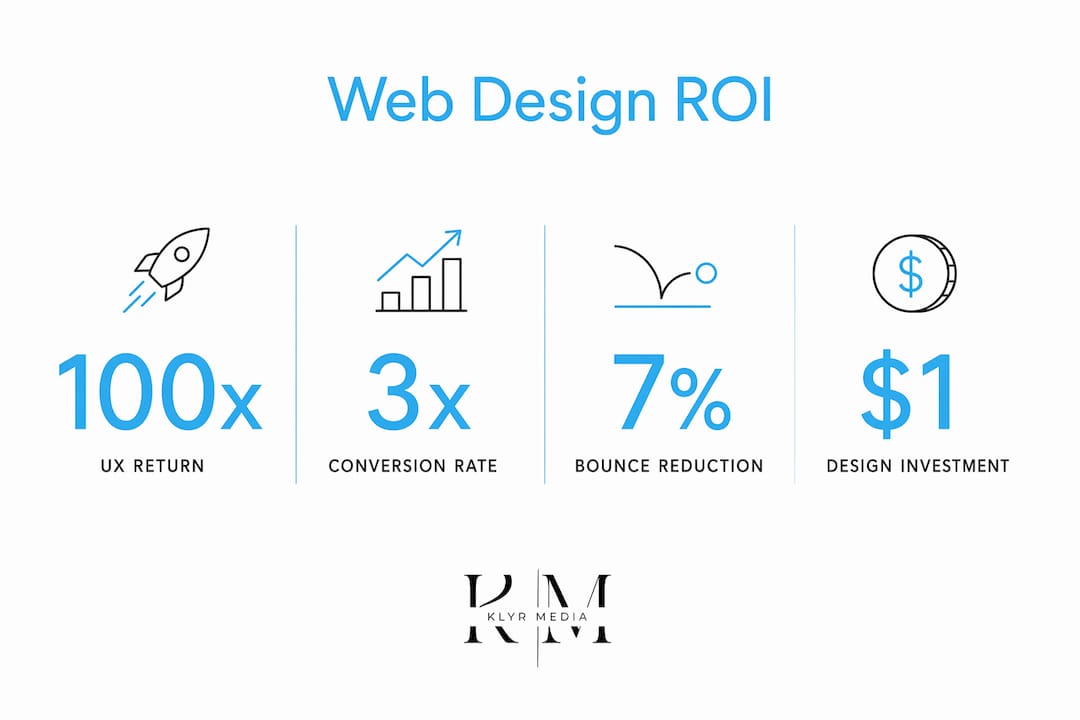
Healthcare sites with strategic design achieve two to three times higher conversion rates by simplifying the patient journey. That is not a marginal gain. That is the difference between a practice that grows and one that stagnates while spending the same marketing budget.
What mistakes do healthcare providers make when investing in web design?
Most of the pain comes from avoidable decisions made early in the process.
-
Choosing a template site to save money. Template-based healthcare websites often lack the SEO architecture and scalable backend your practice needs. When you later try to integrate a HIPAA-compliant patient portal, an appointment booking system, or a CRM, you hit walls. The rebuild costs more than a custom site would have from the start.
-
Prioritizing visual creativity over usability. A site that wins design awards but confuses returning patients is a liability. Usability and consistency improve patient experience and repeat visits far more reliably than trendy animations or unconventional navigation.
-
Ignoring mobile optimization. Over 60% of web traffic now comes from mobile devices, and Google's mobile-first indexing means a poor mobile experience directly suppresses your search rankings. A patient searching "pharmacy near me" on their phone will never find you if your site is not responsive.
-
Skipping accessibility and compliance. ADA-compliant design is not optional for healthcare providers. Inaccessible sites exclude patients with disabilities and expose your practice to legal risk. HIPAA compliance in your web forms and patient data handling is equally non-negotiable.
-
Launching and forgetting. A site that is never measured never improves. Tools like Google Analytics 4 and Google Search Console let you track which pages drive bookings, where patients drop off, and which content attracts organic traffic. Without that data, you are guessing.
Pro Tip: Ask any web design vendor you evaluate whether their deliverable includes Google Analytics 4 setup, a mobile performance audit, and documentation of HIPAA-compliant data handling. If they hesitate, keep looking.
How to align web design investments with your healthcare business goals
Spending money on a new site without a clear goal is how practices end up with a beautiful website that does not move the needle.
Start by defining measurable targets. "We want more patients" is not a goal. "We want to increase online appointment bookings by 30% within six months" is. Specific targets shape every design decision, from where the call-to-action button sits to how the homepage headline is written.
- Map the patient journey before the designer opens a single file. Identify every point where a prospective patient might drop off, from the Google search to the booking confirmation email. Design decisions should reduce friction at each of those points.
- Require HIPAA-compliant design from day one. Retrofitting compliance into an existing site is expensive and disruptive. Build it in from the architecture stage.
- Plan for future integrations. If you intend to add marketing automation, a patient CRM, or an AI chatbot within the next two years, your site's technical architecture needs to support those connections now. Rebuilding later costs time and money you do not have.
- Work with a team that understands healthcare. Generic digital agencies build generic sites. A partner with healthcare-specific experience understands patient psychology, local SEO for medical practices, and the compliance requirements that shape every design choice.
| Approach | Generic agency | Healthcare-specialized partner |
|---|---|---|
| Compliance knowledge | Limited HIPAA awareness | Built-in HIPAA-compliant workflows |
| Patient UX focus | General conversion principles | Patient journey mapping and friction reduction |
| SEO strategy | Broad keyword targeting | Local medical SEO and condition-specific content |
| Integration readiness | Basic CMS setup | CRM, automation, and portal-ready architecture |
What does the impact of professional web design look like in practice?
The scenarios below are not hypothetical. They reflect patterns Klyrmedia sees repeatedly across independent pharmacies and medical clinics.
- A primary care clinic redesigns its site with a prominent "Book Now" button on every page, a simplified new patient form, and a mobile-first layout. Within 90 days, online appointment requests increase significantly, and front-desk call volume for scheduling drops. Staff spend less time on the phone and more time with patients.
- An independent pharmacy replaces its outdated template site with a custom, fast-loading site optimized for local search terms. Organic traffic from patients searching "compounding pharmacy near me" climbs steadily over six months. The pharmacy captures patients who previously found the chain down the street instead.
- A specialty clinic adds a patient-facing FAQ section and service detail pages written for search intent. Younger patients, who research providers online before calling, begin booking at a higher rate. The site functions as a 24/7 patient acquisition engine, lowering the cost of attracting new patients compared to paid advertising alone.
- A multi-location medical practice integrates its website with a patient follow-up automation system. Post-visit satisfaction surveys, appointment reminders, and prescription refill prompts go out automatically. Patient retention improves without adding a single staff member.
The common thread across all of these is that the website stopped being a digital brochure and started functioning as a core part of the practice's growth infrastructure. That shift does not happen by accident. It happens because someone made a deliberate decision to invest in healthcare website design that serves patients rather than just existing online.
Key takeaways
Professional web design is the highest-leverage investment a healthcare provider can make to grow patient volume, reduce acquisition costs, and build lasting credibility in a competitive local market.
| Point | Details |
|---|---|
| First impressions are instant | Visitors form lasting opinions within 50 milliseconds, making design your first clinical decision. |
| ROI is measurable and significant | Every $1 in UX investment returns an average of $100, with conversion lifts of 200% to 400% possible. |
| Templates cost more long-term | Cheap template sites lack HIPAA integration and SEO architecture, leading to expensive rebuilds. |
| Mobile and compliance are non-negotiable | Over 60% of traffic is mobile; HIPAA compliance must be built in from the start, not added later. |
| Inaction compounds losses | Every month a poor site stays live, it bleeds leads and revenue that exceed the cost of a redesign. |
The uncomfortable truth about "good enough" websites
I have worked with enough healthcare providers to recognize a pattern. The practice owner knows the site is outdated. They have been meaning to fix it for two years. But it feels like a low-priority project compared to staffing, billing, and patient care. So it stays.
What they do not see is the revenue that never walked in. The patient who Googled their clinic, landed on a slow, confusing page, and booked with someone else instead. That loss is invisible because it never shows up in a report. Nobody calls to say "I almost became your patient." The compounding cost of a poor site is real, it just does not announce itself.
The other thing I have learned: usability beats creativity every time in healthcare. Patients are not visiting your site to be impressed by design. They are trying to solve a problem quickly. They want to know if you take their insurance, how to book, and where you are located. A site that answers those questions in under 30 seconds wins. A site that makes them hunt loses them, and probably loses them permanently, since 88% of online consumers are less likely to return after a bad experience.
Treat your website as a core business system, not a marketing afterthought. The practices that do are the ones still growing five years from now.
— Opinly
How Klyrmedia helps healthcare providers build websites that work
If any of this resonates, Klyrmedia builds exactly what independent pharmacies and medical practices need: custom, HIPAA-compliant websites designed to convert patients, rank locally, and integrate with your existing systems. Every site is built with patient journey mapping, mobile-first architecture, and compliance baked in from day one.
Beyond design, Klyrmedia's general healthcare solutions connect your website to local SEO, marketing automation, and AI-powered patient engagement tools. The goal is a single growth system, not a collection of disconnected vendors. If you are ready to stop leaving patients on the table, explore what a purpose-built healthcare digital presence looks like.
FAQ
Why does web design matter for patient trust?
75% of consumers judge a company's credibility based entirely on its website design. For healthcare providers, that judgment happens before a patient reads your credentials or reviews.
What is the ROI of investing in web design for a healthcare practice?
Every $1 invested in UX design returns an average of $100, and well-designed interfaces can raise conversion rates by up to 200%. For a medical practice, that translates directly into more booked appointments from existing traffic.
How does poor web design increase patient acquisition costs?
A one-second page load delay reduces conversions by 7%, and slow sites push bounce rates toward 90%. When patients leave before booking, every dollar spent on paid advertising delivers less return.
Should healthcare providers use template websites or custom design?
Template sites typically lack HIPAA-compliant integration options and scalable SEO architecture, making them more expensive long-term due to forced rebuilds. Custom design built for healthcare avoids those limits from the start.
How do I measure whether my web design investment is working?
Use Google Analytics 4 and Google Search Console to track appointment form completions, organic traffic growth, bounce rates, and page-level conversion data. These tools show exactly where your site is winning and where it is losing patients.