

If you're searching for kardiamarketing.com alternatives, the short answer is this: Klyrmedia is the strongest healthcare-specialized replacement, with HIPAA-compliant web design, local SEO, and patient automation built specifically for clinics and independent pharmacies. Beyond Klyrmedia, here's a practical shortlist worth investigating:
- Klyrmedia — full-service healthcare agency; HIPAA-aware architecture, local SEO, PPC, and AI-powered patient engagement
- Katava Marketing — cardiology-focused agency with local SEO and content campaigns targeting first-page search results
- Karda Marketing — AI receptionist platform with 24/7 appointment booking and reputation management
- HubSpot Marketing Hub — general-purpose CRM and automation platform; strong workflows, limited native HIPAA coverage
- Mailchimp — email and basic automation; accessible pricing, not built for healthcare compliance
- Semrush — SEO research and audit toolset; useful for in-house teams, not a managed service
Table of Contents
- Which kardiamarketing.com alternatives actually compare on the metrics that matter?
- What each alternative actually offers versus KardiaMarketing
- How do you choose the right alternative for your practice?
- Why healthcare specialization and HIPAA compliance change everything
- The recommended pick and your next three steps
- Key Takeaways
- A practitioner's perspective on picking the right partner
- Klyrmedia is a direct substitute for KardiaMarketing
- Useful sources and next steps
Which kardiamarketing.com alternatives actually compare on the metrics that matter?
| Alternative | Best for | Core services | HIPAA/compliance | Pricing shape | Onboarding & support | Integrations |
|---|---|---|---|---|---|---|
| Klyrmedia | Independent clinics, pharmacies | HIPAA web design, local SEO, PPC, automation, AI chatbots | HIPAA-compliant architecture; BAA available | Custom monthly retainer | Dedicated onboarding; healthcare-specific | EMR, CRM, appointment systems |
| Katava Marketing | Cardiology and specialty practices | Brand, websites, SEO, content, PR, paid ads, video | Healthcare-focused positioning; verify BAA | Agency retainer; not publicly listed | Full-service agency model | Varies by project |
| Karda Marketing | Small practices needing automation | AI receptionist, booking, reputation, local SEO | Verify BAA before onboarding | Starting around $399/month | Self-serve with guided setup | Phone, text, chat; verify EMR |
| HubSpot Marketing Hub | Multi-location practices with in-house teams | CRM, email, automation, landing pages | Not natively HIPAA-compliant; add-ons required | Starts free; scales to enterprise | Robust documentation; large community | Wide third-party ecosystem |
| Mailchimp | Solo practitioners; basic email outreach | Email campaigns, basic automation, landing pages | Not HIPAA-compliant by default | Free tier; paid plans vary | Self-serve; limited healthcare support | Limited EMR integration |
| Semrush | In-house marketers doing SEO audits | Keyword research, site audit, rank tracking | Not a compliance tool | Pricing varies; contact for details | Self-serve; learning curve | API; limited clinical integrations |
A few things worth flagging after that table:
- Small clinics (1–3 providers) get the most immediate lift from a managed agency like Klyrmedia or Katava, where someone else handles compliance architecture and content governance.
- Multi-site practices with an in-house marketing coordinator can layer HubSpot for CRM workflows on top of a specialist agency's SEO and web work.
- Enterprise health systems typically need a formal vendor risk assessment before any platform touches patient data, so HIPAA documentation from the vendor is non-negotiable.
Stat to keep in mind: Healthcare practices benefit most from vendors that combine local SEO, HIPAA-safe forms and hosting, and conversion-focused website design, not just ad spend alone.
What each alternative actually offers versus KardiaMarketing
Klyrmedia
- What it is: A U.S.-based digital marketing and web development agency built exclusively for healthcare providers.
- Best for: Independent pharmacies, medical clinics, and specialty practices that want a single partner for compliance, SEO, PPC, and patient automation.
- Pricing: Custom monthly retainer; contact for a scoped quote.
- Pros: HIPAA-compliant web design from day one, local SEO with Google Maps optimization, AI chatbots, and predictive analytics baked into the service model.
- Cons: Not a self-serve platform; requires a discovery call to scope the engagement.
- Healthcare relevance: Every service is designed around patient data safety and appointment volume growth, not adapted from a generic agency playbook.
Katava Marketing
- What it is: A full-service agency with over 20 years of experience that focuses on cardiology and broader healthcare client lead generation.
- Best for: Cardiology practices and specialty clinics that want brand, PR, video, and paid ads managed together.
- Pricing: Agency retainer; not publicly listed.
- Pros: Multi-channel playbook combining paid ads, SEO, and video; healthcare-specific case language.
- Cons: Cardiology-heavy positioning may not translate directly to primary care or pharmacy contexts; verify BAA availability.
- Healthcare relevance: Explicitly targets patient lead generation for healthcare organizations with local SEO and content campaigns.
Karda Marketing
- What it is: An AI receptionist and automation platform that answers calls, books appointments 24/7, and manages reputation and local SEO for small businesses.
- Best for: Solo practitioners or small clinics where missed calls are bleeding revenue.
- Pricing: Tiered monthly plans, with example tiers starting around $399/month and $899/month.
- Pros: Immediate impact on missed-call recovery; omnichannel contact via phone, text, and chat.
- Cons: Not a full-service agency; limited content or web design capability; BAA provisions must be verified before any PHI flows through the system.
- Healthcare relevance: Appointment automation and reputation management are directly relevant to patient acquisition, but compliance documentation needs scrutiny.
HubSpot Marketing Hub
- What it is: A general-purpose CRM and marketing automation platform used across industries.
- Best for: Practices with an in-house marketing team that needs workflow automation and contact management.
- Pricing: Free tier available; paid plans scale significantly.
- Pros: Powerful automation, large integration library, strong reporting.
- Cons: Not natively HIPAA-compliant; healthcare teams must configure it carefully and may need a Business Associate Agreement through a third-party add-on.
- Healthcare relevance: Useful as a CRM layer, but not a standalone healthcare marketing solution.
Mailchimp and Semrush
Mailchimp works for basic email outreach at low cost, but it is not HIPAA-compliant by default and lacks meaningful EMR integration. Semrush is a research and audit tool, not a managed service. Both are better thought of as supplements to a specialist agency than replacements for one.
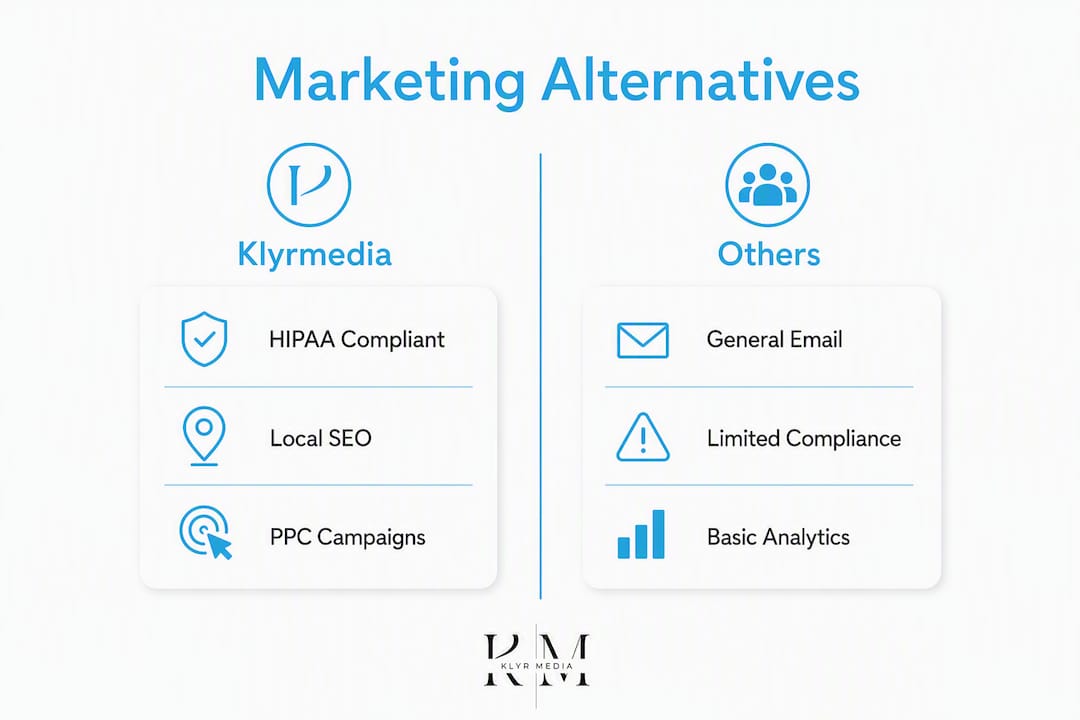
Pro Tip: If a vendor pitches you Mailchimp or a generic email platform as a "HIPAA-compliant" solution, ask them to show you the signed BAA and the specific configuration settings that enforce it. Most can't.
How do you choose the right alternative for your practice?
Work through this in order before you sign anything.
- Confirm HIPAA documentation. Ask every vendor for a signed Business Associate Agreement and their hosting and access-control documentation before the conversation goes further.
- Check healthcare case studies. Generic agency wins don't transfer. Ask for results from a clinic, pharmacy, or specialty practice similar to yours.
- Clarify what "local SEO" actually means. Some vendors mean Google Business Profile updates. A real specialist means technical on-page optimization, citation building, and map-pack strategy working together.
- Ask about EMR and appointment system integrations. If a platform can't connect to your scheduling software, automation value drops fast.
- Get the billing structure in writing. Monthly retainer? Project-based? Performance fees? Know before you sign.
- Understand the reporting cadence. Weekly dashboards or monthly PDF? Who owns the data if you leave?
- Ask about onboarding timeline. A realistic healthcare agency engagement takes 4–8 weeks to get compliant infrastructure in place. Anyone promising results in week one is skipping steps.
Questions to ask every vendor:
- "Can you provide a signed BAA today, or is that a process?"
- "Which EMR or scheduling systems have you integrated with before?"
- "Show me a case study from a practice our size and specialty."
- "What happens to our website and data if we end the contract?"
- "What's your escalation path if something breaks on a Friday night?"
Red flags: No mention of HIPAA anywhere on their site. Pricing that's completely opaque with no example ranges. No healthcare-specific case studies. Guarantees of specific Google ranking positions.
Pro Tip: Request the vendor's BAA template before the sales call ends. A legitimate healthcare-focused agency has one ready. If they need to "check with legal," that's a signal about how often they actually work in regulated environments.
Why healthcare specialization and HIPAA compliance change everything
Generic marketing agencies can run ads. What they can't do is architect a website that handles patient intake forms safely, configure tracking pixels that don't leak PHI to Google's ad servers, or write content that passes both a compliance review and a patient's trust test.

A specialist agency's process looks different from the start. Discovery includes a risk assessment of your current digital footprint. Website builds use HIPAA-safe hosting with access controls and audit logs. Forms are encrypted and routed through compliant channels. Analytics are configured to exclude protected health information from third-party platforms.
What vendors must be able to document:
- A signed Business Associate Agreement covering all services that touch patient data
- Hosting environment details: where data lives, who has access, and how it's encrypted
- Secure form handling: SSL, no PHI in URL parameters, compliant third-party processors
- Content governance: a review process so no post or ad inadvertently discloses patient information
The practical outcome for practices that work with a specialist: stronger local search visibility, higher appointment conversion from web traffic, and a defensible compliance posture if a patient or regulator ever asks questions.
Klyrmedia's service model is built around exactly this integration. HIPAA-compliant web design, local SEO, PPC, and AI-powered patient engagement aren't sold as separate line items bolted together. They're designed to work as a single system, which is why the onboarding process starts with compliance architecture before a single ad goes live.
The recommended pick and your next three steps
For healthcare practices that need HIPAA-aware marketing and full-service delivery, Klyrmedia is the recommended replacement for KardiaMarketing.
Here's what to do this week:
- Run a quick audit of your current setup. What does your existing agency own? Website files, ad accounts, analytics access, domain? Get a list before you start any transition conversation.
- Use the vendor interview checklist above. Take it into every discovery call. The vendors who answer those questions confidently are the ones worth shortlisting.
- Schedule a discovery call with Klyrmedia. Come with your current monthly spend, your top three patient acquisition goals, and a list of the tools you're already using (EMR, scheduling software, CRM). That's all you need to get a scoped proposal.
Plan for a 4–8 week transition window. Internally, you'll want to designate one staff contact who can provide access to existing accounts and coordinate with the new agency during onboarding.
Key Takeaways
For healthcare practices evaluating kardiamarketing.com alternatives, the single most important filter is this: only shortlist vendors who can produce a signed BAA and healthcare-specific case studies before you sign.
| Point | Details |
|---|---|
| HIPAA documentation is non-negotiable | Request a signed BAA and hosting details from every vendor before moving past the first call. |
| Specialist agencies outperform generalists | Vendors built for healthcare handle compliance architecture, content governance, and EMR integrations that generic agencies skip. |
| Automation platforms need scrutiny | AI receptionist tools like Karda can recover missed bookings, but verify BAA provisions before any patient data flows through. |
| Transition takes 4–8 weeks | Audit what your current agency owns, then plan a structured handoff to avoid gaps in web or ad coverage. |
| Klyrmedia is the recommended pick | Full-service HIPAA-compliant web design, local SEO, PPC, and patient automation built exclusively for healthcare providers. |
A practitioner's perspective on picking the right partner
The most common mistake I see healthcare practices make when switching marketing vendors is optimizing for price before compliance. A $500/month agency that doesn't understand BAAs or HIPAA-safe tracking isn't saving you money. It's creating liability. The practices that grow fastest aren't the ones with the biggest ad budgets. They're the ones that built a compliant digital foundation first, then scaled traffic on top of it. Specialization isn't a premium feature. For a regulated industry, it's the baseline.
Klyrmedia is a direct substitute for KardiaMarketing
Most practices switching away from KardiaMarketing need the same core things: a compliant website, local search visibility, and a system that turns web traffic into booked appointments. That's exactly what Klyrmedia delivers, without the generic agency playbook.

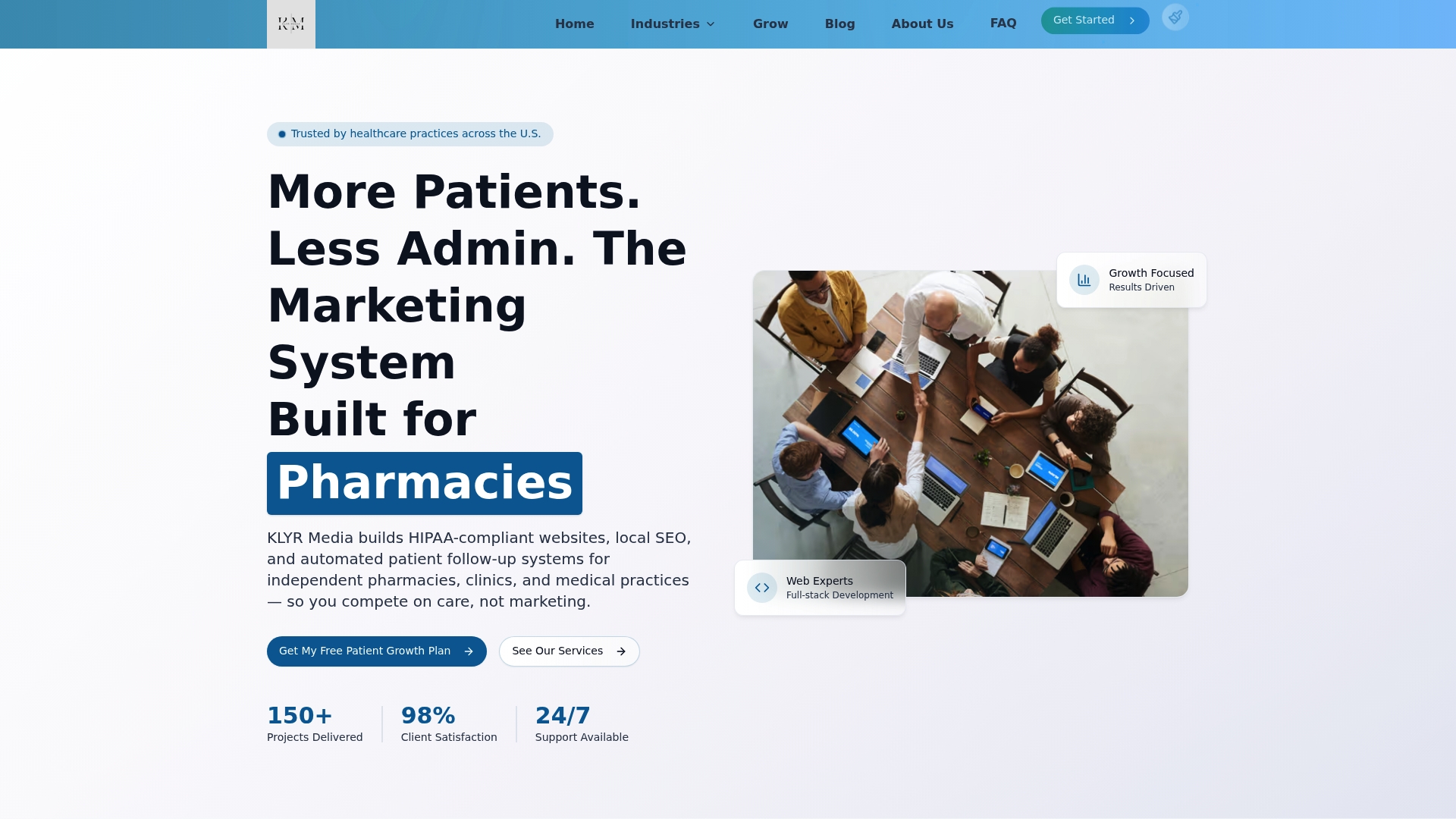
Klyrmedia's services cover HIPAA-compliant website design, local SEO, Google Ads and Bing Ads management, email and SMS automation, and AI-powered patient engagement tools, all scoped and managed for independent pharmacies, medical clinics, and specialty practices across the United States. Onboarding starts with a compliance and discovery phase so your new setup is defensible from day one, not patched together after the fact.
Ready to see what a healthcare-specialized agency actually looks like in practice? Book a discovery call with Klyrmedia and bring your current goals, your existing tool stack, and your questions about HIPAA. The conversation is free; the clarity is immediate.
Useful sources and next steps
Use these to do your own due diligence on vendors and compliance requirements:
- Klyrmedia: HIPAA-Compliant Website Design — service page detailing HIPAA-safe architecture, secure forms, and compliant hosting
- Local SEO for Healthcare Providers: 2026 Guide — step-by-step implementation guide to validate what a specialist agency should deliver
- Local Search Ranking Tips for Healthcare Providers — tactical checklist to use when interviewing agencies on their SEO approach
- What Is Healthcare SEO? — foundational explainer on what separates healthcare SEO from generic search optimization
Before you sign with any vendor on this list: request their BAA template, ask for the hosting environment documentation, and confirm which EMR or scheduling systems they've integrated with previously. Those three documents will tell you more than any sales deck.