
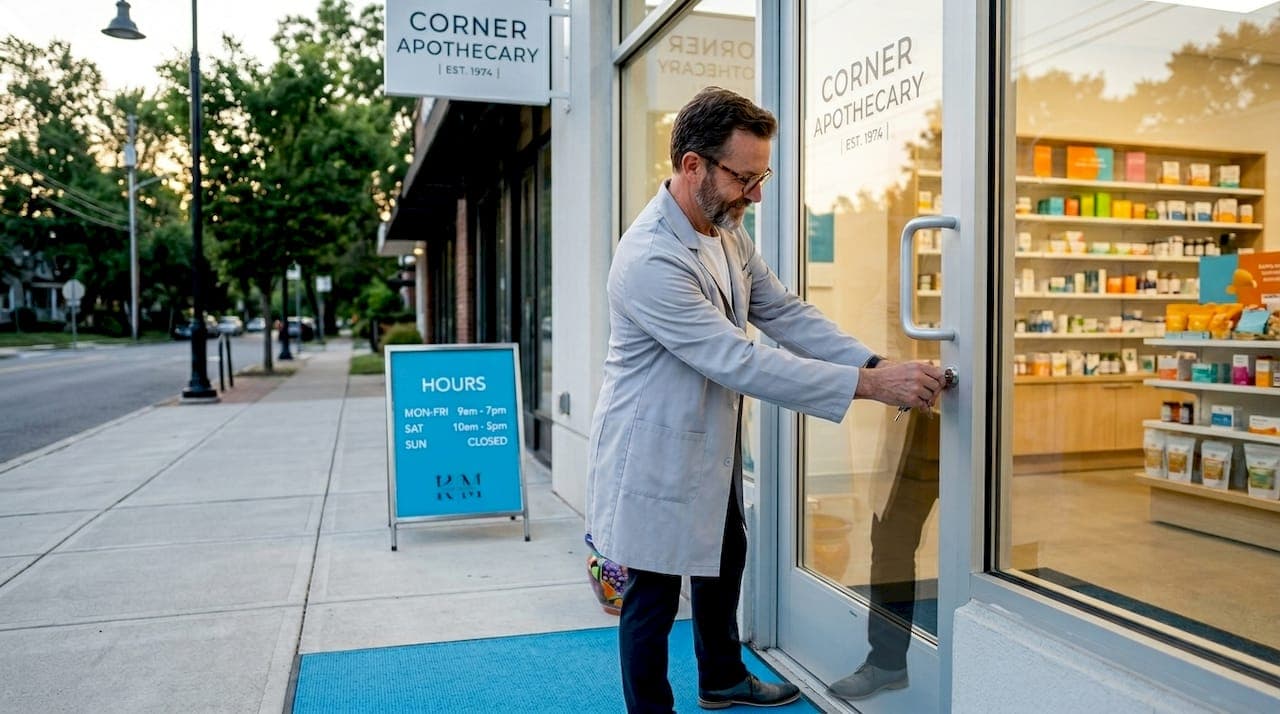
You pour everything into your pharmacy. Long hours, personal service, knowing your patients by name. And yet the waiting room is quieter than it should be. The drive-through at the chain down the street is backed up, but your counter is not. Here is the uncomfortable truth: excellent care alone does not fill scripts or build a loyal patient base. Visibility, reputation, and strategic marketing are the real engines behind growth for independent pharmacies and healthcare providers today. Getting this right is not optional anymore.
Table of Contents
- Why visibility and reputation are business essentials
- Marketing across the patient journey: Acquisition, engagement, retention
- What works: Avoiding cookie-cutter marketing and measuring what matters
- How marketing empowers engagement in value-based care
- The overlooked reality: Marketing is patient care, too
- Accelerate your growth with the right healthcare marketing partner
- Frequently asked questions
Key Takeaways
| Point | Details |
|---|---|
| Visibility is vital | Independent providers need marketing to ensure patients know their business even exists. |
| Patient retention drives growth | Keeping existing patients is more important than ever for sustainable practice success. |
| Tailor and measure efforts | Customizing marketing for your context and tracking actionable patient behaviors pays off. |
| Marketing supports value-based care | Marketing is essential for engaging patients and bridging care gaps in new healthcare models. |
| Every touchpoint matters | Patients judge your practice from their first online interaction—marketing is part of their care experience. |
Why visibility and reputation are business essentials
Let's start with a hard reality. You can have the friendliest staff, the fastest turnaround, and the most personalized service in town. But if a new patient Googles "pharmacy near me" and your name does not appear, they are going to the chain that does. That is not a service problem. That is a visibility problem.

As the industry has recognized, independent pharmacies face a marketing challenge that is just as much about being seen as it is about service quality. Patients cannot choose you if they do not know you exist. This is the "invisible pharmacy" trap, and far too many independent operators fall into it while focusing entirely on what happens inside their four walls.
What changes this equation? A strong digital presence paired with an actively managed reputation.
Your Google Business Profile is often the first thing a potential patient sees. If it is incomplete, has outdated hours, or shows no reviews, it sends a signal before the person even walks in. And those reviews matter enormously. Online reviews and reputation signals materially influence which provider a patient chooses, especially for patients who are new to an area or switching from a chain.
Here is what the visibility gap really looks like in practice:
- A patient relocates to your neighborhood. They search online, see three pharmacies, read reviews, and pick one. If your pharmacy has 12 reviews and a competitor has 200, you already lost that patient before they left their couch.
- A caregiver managing a parent's medications asks a neighbor for recommendations. That neighbor checks your Facebook page and finds the last post is from 2023. They move on.
- A local doctor's office considers recommending a pharmacy for their diabetic patients. They look you up. Your website loads slowly and is not mobile-friendly. That referral goes elsewhere.
"Independent pharmacies need to think of marketing as infrastructure, not a luxury. Just as you maintain your dispensing systems and comply with board regulations, you need to maintain your digital presence to stay in the game."
The fix starts with claiming and optimizing your local listings, building a review generation process into your workflow, and investing in pharmacy marketing solutions that are built for your specific competitive context. Using local marketing strategies tailored to your community is not just smart, it is essential for survival against national chains with massive advertising budgets.
Marketing across the patient journey: Acquisition, engagement, retention
Once you understand that visibility is a prerequisite, the next step is recognizing that marketing is not a one-time event. It is an ongoing relationship with your patient base across three distinct stages: acquisition, engagement, and retention.
Healthcare marketing drives outcomes at every stage of the patient journey, from initial discovery through long-term loyalty. Each stage requires different tools, different messages, and different success metrics. Treating them the same way is one of the most common mistakes independent providers make.
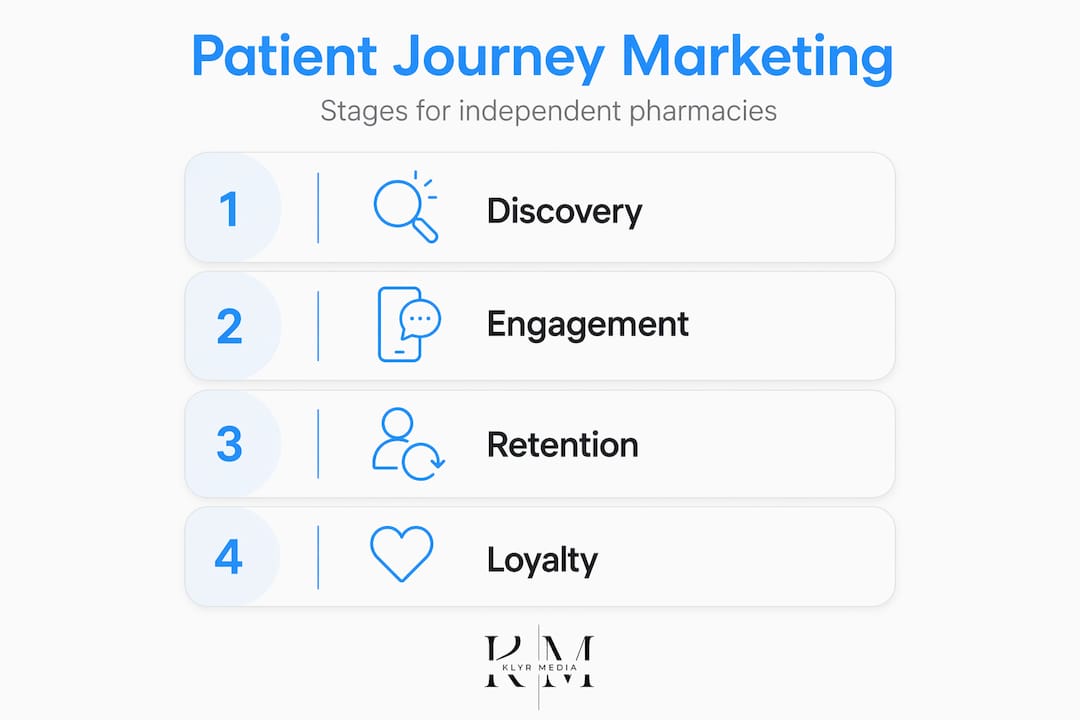
Here is a breakdown of what each stage looks like in practice:
| Stage | Goal | Key tactics | Measurable outcomes |
|---|---|---|---|
| Acquisition | Get new patients in the door | Local SEO, Google Ads, referral campaigns | New patient visits, script volume |
| Engagement | Build trust and consistent interaction | Email newsletters, wellness content, loyalty programs | Open rates, refill adherence, appointment bookings |
| Retention | Keep patients long-term | Follow-up automation, patient education, personalized outreach | 90-day refill rates, patient lifetime value |
Let's walk through each one more specifically.
-
Acquisition is about discoverability and first impressions. This is where local SEO, pay-per-click advertising, and a strong website come in. Think about targeted patient acquisition as casting a net in the right pond. You do not need to reach everyone. You need to reach the right patients in your zip code who are searching for services you offer.
-
Engagement is the middle ground that most pharmacies ignore. A patient fills their first prescription and then you never hear from them again. No follow-up. No refill reminder. No educational email about their medication. You are leaving the relationship on the table. Engagement tactics like automated refill reminders, health tips tied to their conditions, and even a simple birthday message build the kind of familiarity that drives loyalty.
-
Retention is where the real money is. Rising costs and workforce pressures are pushing providers to prioritize keeping their existing patients rather than constantly chasing new ones. The math is straightforward: acquiring a new patient costs significantly more than retaining one. If your pharmacy loses 20% of its patient base every year due to poor follow-up, that is revenue walking out the door every single month.
Pro Tip: Segment your patient list by condition or medication type. A diabetic patient needs different content than someone picking up a one-time antibiotic. Personalized outreach dramatically improves both refill rates and patient satisfaction scores.
Explore the full patient experience marketing phases to understand how to build a marketing system that works across all three stages simultaneously.
What works: Avoiding cookie-cutter marketing and measuring what matters
Here is where a lot of independent pharmacies get burned. They sign up for a generic "healthcare marketing package" from a vendor who treats every client the same. Same social posts. Same email templates. Same Google Ads copy. The results are predictably flat.
Cookie-cutter healthcare marketing underperforms because healthcare is not a uniform marketplace. A rural compounding pharmacy has completely different patient needs than an urban specialty pharmacy serving HIV patients. Your positioning, your services, your community demographics all change what marketing works for you.
What does tailored marketing look like in practice? Consider these contrasts:
| Generic approach | Tailored approach |
|---|---|
| Broad keyword targeting like "pharmacy" | Hyper-local keywords like "compounding pharmacy [your city]" |
| Generic social posts about flu season | Posts featuring your pharmacist's face and a local health event you attended |
| One-size-fits-all email newsletters | Segmented emails by patient condition or medication category |
| Tracking clicks and impressions only | Tracking new patient conversions and 90-day refill rates |
The measurement piece is critical. Clicks are vanity. What actually matters is whether marketing produces profitable patient behavior like new patient capture, medication adherence, and referral conversions. If you are running Google Ads and your vendor is showing you click-through rates but not new patients acquired, you are measuring the wrong things.
Here is what you should be tracking:
- New patient scripts filled per month traced back to specific campaigns
- Refill rate percentage for patients acquired through digital channels
- Cost per acquisition for each marketing channel you invest in
- Online review velocity meaning how many new reviews you are generating per month
Pro Tip: Before signing any marketing contract, ask the vendor point blank: what conversion events will you track, and how will you connect them to actual patient actions, not just website visits?
Knowing which effective healthcare keywords drive real conversions versus just traffic is a skill. And learning how to optimize your Google Ads for patient intent rather than generic health searches is where independent pharmacies start to close the gap with bigger competitors. If you are new to paid advertising, starting with structured healthcare PPC strategies built specifically for healthcare compliance and conversion can save you a lot of wasted spend.
How marketing empowers engagement in value-based care
The conversation around marketing keeps evolving, especially as value-based care becomes more central to how healthcare providers are reimbursed. This matters for pharmacies and clinics alike.
Value-based care models like ACO REACH put coordinated, data-driven care at the center. Care gap management, patient transitions, and engagement are not just clinical priorities. They are reimbursement drivers. And this is exactly where proactive marketing and patient communication become clinical assets, not just business tools.
Think about it this way. A patient gets discharged from a hospital and is starting a new medication regimen. If your pharmacy has automated outreach in place, that patient gets a call or text within 24 hours confirming their prescription is ready and explaining what to expect. That one touchpoint reduces abandonment, supports adherence, and strengthens the care transition. That is marketing doing clinical work.
Here is what patient engagement marketing looks like when it is aligned with value-based care goals:
- Medication adherence campaigns that remind patients to refill before they run out, reducing gaps in therapy
- Educational content delivered via email or SMS that explains why their medication matters, in plain language
- Appointment reminders and follow-up messages that close the loop after a health event like a hospitalization or new diagnosis
- Wellness campaigns tied to chronic disease management programs you already offer, like diabetes or hypertension coaching
"When a patient feels heard, educated, and followed up with consistently, they are more likely to stay on therapy, return to your pharmacy, and refer others. That is the intersection of marketing and care."
Building brand trust through engagement is not a soft metric. It shows up in refill rates, quality scores, and ultimately in your bottom line. And following compliance marketing best practices ensures that your outreach stays HIPAA-compliant while still being personal and effective. Even something as simple as consistent email engagement can meaningfully improve the patient relationship when done with the right content and cadence.
The overlooked reality: Marketing is patient care, too
Here is the perspective that most marketing conversations miss entirely. We tend to think of marketing as something that happens before the patient walks through your door, and care as something that happens after. But that line is blurring fast, and the providers who recognize it are winning.
A patient's experience with your pharmacy starts the moment they look you up online. What does your Google listing say? Is your website easy to navigate on a phone? Do you have photos, a clear list of services, hours that are actually accurate? All of that is their first impression of your care.
If the experience before they arrive feels disorganized or outdated, they have already formed a judgment about the care they will receive inside. This is not irrational. It is human. We use visible signals to make inferences about quality. Your digital presence is one of those signals.
That is why we genuinely believe that reframing marketing as an extension of patient care is the single most powerful mindset shift an independent pharmacy owner can make. It stops marketing from feeling like an annoying expense and starts it feeling like the right thing to do for your patients.
When you invest in holistic engagement strategies that connect your digital presence to your in-person experience, something shifts. Patients feel seen before they even walk in. They feel supported between visits. And they feel loyal to a pharmacy that treats their health as a priority at every touchpoint.
The independent pharmacy's greatest competitive advantage over chains has always been the human connection. Marketing just extends that connection into the digital world where patients are already spending most of their time.
Accelerate your growth with the right healthcare marketing partner
You already know how to take care of patients. What you might need is a system that brings more of the right patients to you, keeps them engaged, and makes your practice more resilient to the pressures of PBM clawbacks, DIR fees, and staffing shortages.
At KLYR Media, we build HIPAA-compliant web design and marketing systems specifically for independent pharmacies and healthcare providers across the U.S. From local SEO and targeted advertising to automated patient follow-up and reputation management, everything we do is built around your specific market, your specific patient population, and your specific growth goals. Our digital healthcare solutions are not templated. They are engineered to perform in the real competitive environment you operate in every day. If you are ready to stop leaving patients to the chains, the KLYR Media team is ready to help you build a marketing system that works as hard as you do.
Frequently asked questions
How does healthcare marketing help independent pharmacies compete with chains?
Healthcare marketing increases visibility, builds local trust, and activates online reviews to attract patients who might otherwise default to a large chain. Independent pharmacies face a visibility problem as much as a service quality problem, and marketing is the solution.
Why is patient retention more important now than before?
Rising costs and staffing constraints make it far more expensive to constantly replace patients who leave, so retaining existing patients protects reimbursements, quality scores, and long-term profitability.
What digital marketing tools are most important for healthcare providers?
The highest-impact tools include reputation management, targeted local ads, segmented email campaigns, and educational content that meets patients where they already are online.
Do online reviews really influence patient choices?
Absolutely. Online reviews and search signals materially influence which provider a patient selects, making review generation a core business priority, not a nice-to-have.
How does marketing support value-based care programs?
Marketing tools like automated follow-ups, adherence campaigns, and educational outreach directly support the care coordination and gap management goals that determine reimbursement outcomes in value-based models like ACO REACH.